
SCADA Software
SCADA system Architecture: ATSCADA System Architecture
A practical SCADA architecture must clearly define how data moves from industrial devices to users. Instead of focusing only on software design, system architecture describes how servers, clients, and networks work together in real operation.
ATSCADA follows a centralized system model where all data is processed on a server and distributed to different types of clients. This structure ensures consistent data handling and reliable system control in modern SCADA software
ATSCADA System Architecture Overview
The ATSCADA system is built around a central server that connects industrial devices and user interfaces, based on a flexible SCADA development platform. All components communicate through this server, making it the core of the entire system.
The architecture includes three main parts:
- Server (data processing and control)
- Windows clients (local operation)
- Web clients (remote access)
This structure allows multiple users to access the system simultaneously without conflict.
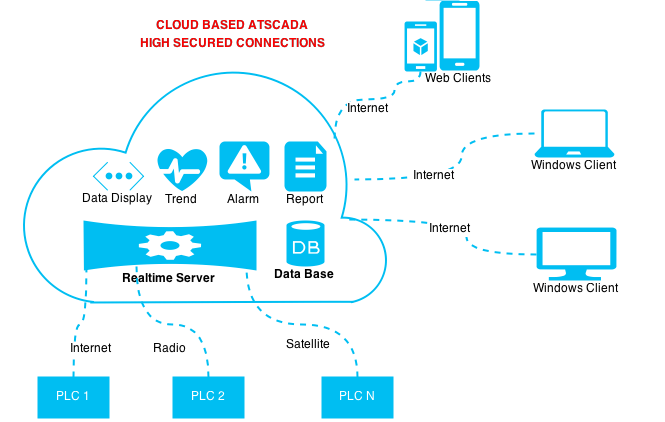
How the SCADA Architecture Operates
Server and Data Processing
The server collects data from PLCs and field devices, a fundamental concept explained in how SCADA systems work
By centralizing data processing, the system ensures that every client receives the same and most up-to-date information.
Client Access and Control
Users interact with the system through two types of clients.
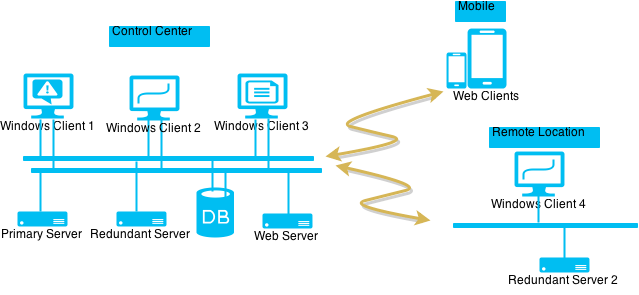
- Windows clients are used in control rooms for full monitoring and control.
- Web clients allow remote access through browsers and mobile devices.
As a result, operators can manage the system both locally and remotely during real-world SCADA project implementation
Data Flow in the System
The operation of this SCADA architecture follows a clear sequence:
- Field devices send data to the server
- The server processes and stores the data
- Clients request data from the server
- The server returns real-time information to users
This centralized flow keeps all system data synchronized.
Advantages of ATSCADA System Architecture
Consistent Data Handling
All data is processed on a single server, ensuring accuracy across the system.
Flexible Access
Users can access the system from different locations using Windows or web clients.
Scalable Structure
The system can expand by adding more devices or clients without changing the core design.
Efficient Operation
Real-time monitoring allows operators to respond quickly to system changes.
Applications of SCADA Architecture
This SCADA architecture is suitable for industrial environments that require centralized control and distributed access, such as:
- Manufacturing systems
- Energy management
- Water treatment
- Industrial automation
These systems benefit from reliable data processing and flexible monitoring.
Conclusion
The ATSCADA system demonstrates a practical SCADA architecture built around a central server and multiple client types. By separating data processing from user access, the system ensures reliable operation and consistent performance.
This structure provides an effective solution for modern industrial monitoring and control.
ATSCADA - Providing ATSCADA software - The monitoring and data acquisition control system is the appropriate choice for integrated system projects, IoT, smart city projects, agriculture 4.0... Is trusted by many customers.
Related posts
SCADA Architecture: Complete Guide to Modern Industrial Systems with ATSCADA Software
Introduction In modern industrial environments, efficiency, reliability, and data-driven decision-making are no longer optional—they are [...]
Apr
SCADA Demo: Testing ATSCADA Before Deployment
A scada demo allows businesses to explore real-time monitoring, control systems, and industrial data management [...]
Apr
Free SCADA Software – Industrial Monitoring with ATSCADA
In the age of Industry 4.0, businesses are under increasing pressure to digitize operations while [...]
Apr
ATSCADA – The Best SCADA Software Download for Industrial Automation
If you are searching for a reliable SCADA software download, ATSCADA is a powerful solution [...]
Apr
ATSCADA Software: A Next-Generation Web & Cloud SCADA Platform for Industry 4.0
Introduction to ATSCADA Lab ATSCADA Lab serves as the core Research and Development division of [...]
Mar
SCADA System Development in ATSCADA: Research Foundations and Architecture Design
SCADA system development has evolved significantly in recent years, moving from monolithic architectures to modular, [...]
Mar