
SCADA Software
SCADA Architecture: Complete Guide to Modern Industrial Systems with ATSCADA Software
Introduction
In modern industrial environments, efficiency, reliability, and data-driven decision-making are no longer optional—they are essential. Industries such as manufacturing, energy, oil and gas, water treatment, and smart infrastructure increasingly rely on automation systems to maintain performance and competitiveness. At the core of these systems lies SCADA architecture, a structured framework that enables real-time monitoring, control, and optimization of industrial processes.
SCADA, which stands for Supervisory Control and Data Acquisition, is not simply a software solution but an entire ecosystem that integrates hardware, communication networks, and data management systems. The architecture behind SCADA determines how effectively data flows from field devices to operators and decision-makers.
A well-designed SCADA architecture allows organizations to monitor operations in real time, detect anomalies, optimize performance, and scale their systems as needed. Whether you are implementing a SCADA monitoring system for a small facility or deploying a large distributed industrial network, the architecture plays a critical role in system success.
This guide provides a comprehensive exploration of SCADA architecture, including its components, evolution, deployment models, and best practices. It is designed to help engineers, system integrators, and decision-makers understand how to build modern SCADA systems using solutions like ATSCADA Software.
Understanding SCADA Architecture
SCADA architecture refers to the structural design that defines how different components within a SCADA system interact with each other. These components include field devices, communication networks, servers, and user interfaces.
At its core, SCADA architecture defines how data is collected, transmitted, processed, and presented. It determines how signals from sensors are converted into meaningful insights that operators can use to make decisions.
Unlike traditional automation systems, which operate in isolated environments, SCADA systems are designed to manage distributed processes. This means that a SCADA architecture must support communication across multiple locations, devices, and users.
One of the key aspects of SCADA architecture is its ability to centralize control while maintaining distributed data acquisition. Field devices such as PLCs and RTUs operate locally, but their data is transmitted to a central system where it is processed and visualized.
This centralized approach enables operators to monitor entire industrial systems from a single interface, improving efficiency and reducing response time.
Evolution of SCADA Architecture
The evolution of SCADA architecture reflects the broader evolution of industrial technology.
In the early stages, SCADA systems were monolithic. They relied on large mainframe computers and proprietary hardware. These systems were expensive, difficult to maintain, and limited in scalability.
As networking technologies developed, SCADA systems transitioned into distributed architectures. Instead of relying on a single central system, multiple nodes could communicate and share data. This improved flexibility and allowed systems to scale more easily.
The introduction of LAN and WAN networks marked another significant milestone. SCADA systems could now connect devices across different locations, enabling centralized monitoring of geographically distributed assets.
Today, SCADA architecture has entered a new phase with the integration of cloud computing and Industrial IoT (IIoT). Modern systems can collect data from thousands of devices, process it in real time, and provide remote access through web-based interfaces.
This evolution has transformed SCADA from a simple monitoring tool into a powerful platform for digital transformation.
Core Components of SCADA Architecture
A modern SCADA architecture consists of several key components that work together to ensure efficient operation.
Field Devices
Field devices are the foundation of any SCADA system. These include sensors, actuators, PLCs, and RTUs. They are responsible for collecting real-time data from industrial processes.
Sensors measure physical parameters such as temperature, pressure, and flow. PLCs process these signals and execute control logic, while RTUs are often used in remote locations to transmit data back to the central system.
Communication Network
The communication network connects field devices to the central SCADA system, using wired or wireless technologies such as Ethernet, fiber optics, or cellular connections.
Engineers use communication protocols such as Modbus, OPC UA, and DNP3 to ensure reliable data transmission between devices.
SCADA Server
The SCADA server acts as the brain of the system. It collects data from field devices, processes it, and stores it for analysis. The server also manages alarms and sends control commands back to the field.
HMI (Human Machine Interface)
The HMI provides a visual interface for operators. It displays real-time data, system status, and alarms, allowing users to monitor and control processes.
Data Storage and Analytics
Modern SCADA systems include advanced data storage and analytics capabilities. Historical data can be analyzed to identify trends, optimize performance, and predict failures.
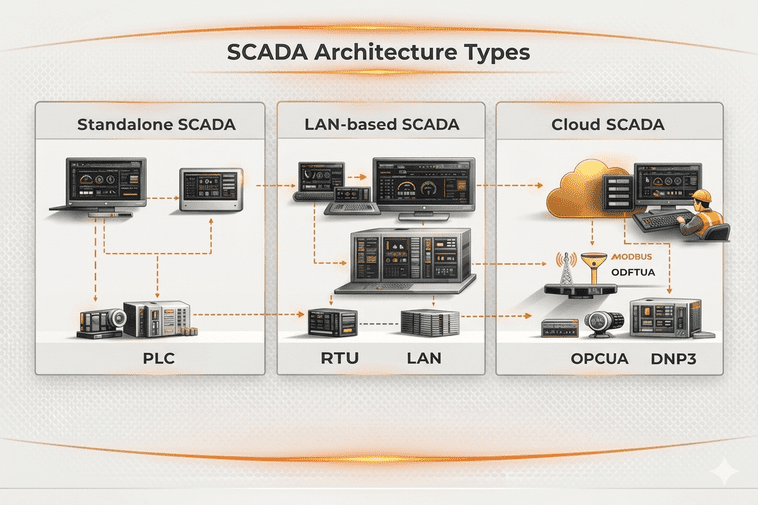
Types of SCADA Architecture
Different industrial applications require different SCADA architectures.
Standalone SCADA Systems
Standalone systems are simple and operate locally. They are suitable for small-scale applications where remote access is not required.
SCADA in LAN
LAN-based SCADA systems connect multiple devices within a local network. These systems offer high speed and reliability, making them ideal for factories and industrial plants.
Cloud SCADA Systems
Cloud-based SCADA systems enable remote monitoring and control. They are highly scalable and support advanced analytics.
Hybrid SCADA Systems
Hybrid systems combine local and cloud architectures, providing both reliability and flexibility.
SCADA Data Flow Explained
Data flow is a critical aspect of SCADA architecture.
The process begins with sensors collecting data from the physical environment. This data is transmitted to PLCs, which process it and send it to the SCADA server.
The server analyzes the data and stores it in a database. The HMI then displays the information to operators, allowing them to monitor and control the system.
Efficient data flow ensures real-time performance and accurate decision-making.
SCADA Architecture Design Principles
Designing an effective SCADA architecture requires careful consideration of several factors.
Scalability is essential to ensure that the system can grow as needed. Reliability is critical to prevent downtime and ensure continuous operation.
Security is increasingly important as SCADA systems become more connected. Protecting against cyber threats is a top priority.
Performance must also be optimized to ensure real-time responsiveness.
Finally, interoperability is necessary to integrate SCADA systems with other technologies such as IoT and enterprise software.
SCADA Architecture with ATSCADA Software
ATSCADA Software provides a flexible platform for implementing modern SCADA architectures.
It supports multiple deployment models, including standalone, LAN, and cloud systems. Its modular design allows users to customize the system based on their needs.
With real-time monitoring, advanced data processing, and web-based access, ATSCADA enables organizations to build scalable and efficient SCADA systems.
Real-World Applications
SCADA systems are used in a wide range of industries.
In manufacturing, they monitor production lines and optimize efficiency. In energy systems, they manage power distribution and detect faults.
Water treatment facilities use SCADA to monitor flow and ensure quality. Smart cities rely on SCADA for infrastructure management and traffic control.
Challenges and Future Trends
Despite its benefits, SCADA architecture faces several challenges, including cybersecurity risks and integration with legacy systems.
However, emerging technologies such as AI, IoT, and edge computing are driving the future of SCADA systems.
These innovations will enable more intelligent, efficient, and scalable industrial systems.
Comparison of SCADA Architecture Models
Choosing the right SCADA architecture is one of the most critical decisions in industrial automation. Each model—standalone, LAN-based, cloud-based, or hybrid—offers different advantages depending on the scale, complexity, and operational requirements of the system.
Engineers typically use standalone SCADA systems in small-scale environments where monitoring is limited to a single machine or a localized process. These systems offer simple deployment and cost-effectiveness, but they lack scalability and remote access capabilities. They are ideal for applications that do not require real-time remote monitoring.
In contrast, SCADA architecture in LAN environments provides a more robust and scalable solution. By connecting multiple PLCs and devices within a local network, organizations can achieve centralized monitoring with high-speed communication. This model is widely used in manufacturing plants where reliability and performance are critical.
Cloud SCADA architecture takes scalability and accessibility to the next level. By leveraging internet connectivity, cloud-based systems allow operators to monitor and control industrial processes from anywhere in the world. This is particularly useful for distributed systems such as energy grids or water management networks. However, cloud systems also introduce challenges related to cybersecurity and network dependency.
Hybrid SCADA architecture combines the strengths of both LAN and cloud systems. It allows critical operations to run locally while enabling remote monitoring and analytics through the cloud. This approach provides a balance between reliability and flexibility, making it increasingly popular in modern industrial environments.
From a strategic perspective, organizations should evaluate factors such as system size, required uptime, security requirements, and budget before choosing an architecture. In many cases, hybrid solutions offer the best long-term value.
SCADA Cybersecurity Architecture
As SCADA systems become more connected, cybersecurity has become a major concern. Industrial control systems are increasingly targeted by cyber threats, making security a critical component of SCADA architecture.
Network Segmentation in SCADA Systems
A secure SCADA architecture must include multiple layers of protection. Network segmentation is one of the most effective strategies. By separating the SCADA network from corporate IT systems, organizations can significantly reduce the risk of unauthorized access and lateral movement within the network.
Firewalls, IDS, and Data Encryption
Firewalls and intrusion detection systems (IDS) are essential for protecting SCADA environments. These tools continuously monitor network traffic and identify potential threats before they can cause damage. In addition, encryption should be implemented to secure data transmitted between devices, ensuring data integrity and confidentiality.
Authentication and Access Control
Authentication and access control play a critical role in SCADA cybersecurity. Only authorized personnel should be allowed to access the system, and permissions should be assigned based on roles and responsibilities. This minimizes the risk of insider threats and prevents unauthorized system manipulation.
Patch Management and System Updates
Regular updates and patch management are crucial for maintaining a secure SCADA architecture. Outdated software often contains vulnerabilities that attackers can exploit. Organizations should implement a structured update process to ensure all system components remain up to date and protected against known threats.
Monitoring and Incident Response
Continuous monitoring and effective incident response are key elements of SCADA cybersecurity. Systems should be designed to detect anomalies and respond quickly to potential threats. This includes event logging, real-time alerts, and automated responses to mitigate risks before they escalate.
By integrating cybersecurity into the design of SCADA architecture, organizations can protect their systems and ensure reliable, uninterrupted operation.
Real-World SCADA Architecture Use Cases
Understanding how engineers apply SCADA architecture in real-world scenarios provides valuable insights into its practical benefits.
Manufacturing Industry
Manufacturing environments use SCADA systems to monitor production lines, track machine performance, and optimize efficiency.. A typical setup includes multiple PLCs connected to a central SCADA server within a LAN.
Operators can monitor real-time data such as production rates, machine status, and quality metrics. This allows them to identify issues quickly and reduce downtime. Advanced systems may also integrate predictive maintenance, using historical data to anticipate equipment failures.
Energy and Power Systems
SCADA architecture plays a critical role in power generation and distribution. Utilities use SCADA systems to monitor substations, manage load distribution, and detect faults.
Engineers deploy RTUs in remote locations to collect data and transmit it to a central control center. Organizations increasingly use cloud SCADA solutions to enable real-time monitoring across large geographic areas.
Water Treatment and Utilities
Water treatment facilities rely on SCADA systems to monitor flow rates, pressure levels, and water quality. These systems ensure that operations remain within safe parameters.
SCADA architecture allows operators to automate processes such as chemical dosing and filtration. It also provides real-time alerts in case of anomalies, helping to prevent system failures.
Smart Cities and Infrastructure
In smart city applications, SCADA systems are used to manage infrastructure such as traffic systems, lighting, and public utilities.
Cloud-based SCADA architecture enables centralized monitoring of distributed assets, improving efficiency and reducing operational costs. These systems also support data analytics, helping cities make informed decisions.
Advanced SCADA Architecture Design Strategies
Designing a high-performance SCADA system requires more than just selecting the right components. It involves strategic planning and optimization.
One important strategy is modular design. By dividing the system into smaller, independent modules, organizations can improve scalability and simplify maintenance. This approach also allows for easier upgrades and integration with new technologies.
Another key strategy is redundancy. Critical systems should include backup components to ensure continuous operation in case of failure. This may involve redundant servers, communication paths, or power supplies.
Load balancing is also important in large-scale systems. By distributing workloads across multiple servers, organizations can improve performance and prevent bottlenecks.
Edge computing is becoming increasingly relevant in SCADA architecture. By processing data closer to the source, edge devices can reduce latency and improve real-time performance. This is particularly useful in applications where immediate response is required.
Finally, standardization plays a crucial role. Using open standards and protocols ensures compatibility between different components and reduces dependency on specific vendors.
SCADA Architecture vs Traditional Automation Systems
Engineers often compare SCADA systems with traditional automation systems, but they highlight several significant differences between the two.
Traditional automation systems typically operate at a local level, focusing on controlling individual machines or processes. These systems usually have a limited scope and lack centralized monitoring capabilities.
In contrast, engineers design SCADA architecture for large-scale systems. It enables centralized monitoring of distributed assets and provides a comprehensive view of operations.
Another key difference lies in data management. SCADA systems collect and store large volumes of data, allowing organizations to perform advanced analytics and make informed decisions. Traditional systems often offer limited data storage and analysis capabilities.
SCADA systems also support remote access, allowing operators to monitor and control processes from virtually anywhere. Traditional automation systems typically do not provide this level of accessibility.
Frequently Asked Questions (FAQ)
What is SCADA architecture used for?
Engineers use SCADA architecture to design systems that monitor and control industrial processes in real time. Industries such as manufacturing, energy, and water treatment widely adopt it.
What is the difference between SCADA and PLC?
Engineers use a PLC for local control of machines, while they use SCADA systems to monitor and control multiple devices across a network.
What is the best SCADA architecture?
The best architecture depends on the application. Small systems may use standalone SCADA, while larger systems benefit from LAN or cloud-based architectures.
Is cloud SCADA secure?
Organizations can secure cloud SCADA by implementing proper cybersecurity measures, including encryption, authentication, and network segmentation.
What industries use SCADA systems?
Industries such as manufacturing, energy, oil and gas, water treatment, and smart cities use SCADA systems.
What is SCADA data flow?
SCADA data flow refers to the process of collecting data from sensors, processing it, and displaying it to operators for monitoring and control.
Conclusion
SCADA architecture is a critical component of modern industrial automation. By understanding its components, design principles, and deployment models, organizations can build systems that are efficient, scalable, and secure.
With solutions like ATSCADA Software, businesses can leverage advanced technologies to create powerful SCADA systems that meet the demands of today’s industrial landscape.
ATSCADA - Providing ATSCADA software - The monitoring and data acquisition control system is the appropriate choice for integrated system projects, IoT, smart city projects, agriculture 4.0... Is trusted by many customers.
Related posts
SCADA Demo: Testing ATSCADA Before Deployment
A scada demo allows businesses to explore real-time monitoring, control systems, and industrial data management [...]
Apr
Free SCADA Software – Industrial Monitoring with ATSCADA
In the age of Industry 4.0, businesses are under increasing pressure to digitize operations while [...]
Apr
ATSCADA – The Best SCADA Software Download for Industrial Automation
If you are searching for a reliable SCADA software download, ATSCADA is a powerful solution [...]
Apr
ATSCADA Software: A Next-Generation Web & Cloud SCADA Platform for Industry 4.0
Introduction to ATSCADA Lab ATSCADA Lab serves as the core Research and Development division of [...]
Mar
SCADA System Development in ATSCADA: Research Foundations and Architecture Design
SCADA system development has evolved significantly in recent years, moving from monolithic architectures to modular, [...]
Mar
ATSCADA Distributor – Visual Studio SCADA Global Network
ATSCADA collaborates with a global network of international distributors and system integrators to deliver Web-based [...]
Mar