
SCADA Basics
SCADA Monitoring System: Simple Architecture for Local and Standalone Applications
Not every industrial system requires a complex or distributed SCADA infrastructure. In many situations, a compact SCADA Network built on a single workstation is more practical , especially in systems based on SCADA core principles. With ATSCADA, users can deploy a standalone monitoring application that delivers real-time control, data visualization, and alarm management without the need for multiple servers or network layers.
This approach is especially suitable for localized systems where simplicity and reliability are more important than scalability.
Understanding ATSCADA Standalone Systems
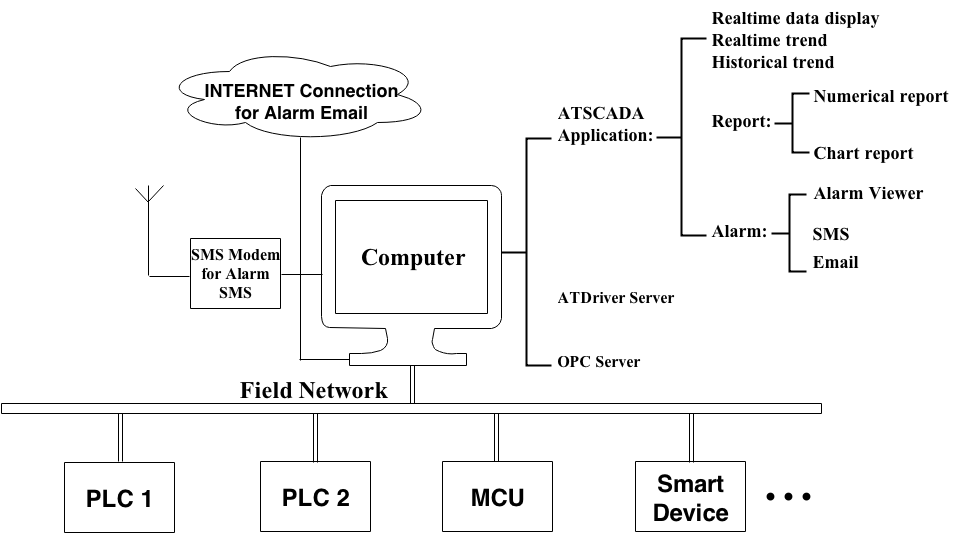
A standalone ATSCADA setup operates as a self-contained SCADA Network, where all core functions are handled within one computer. Instead of distributing tasks across multiple nodes, the system centralizes monitoring, processing, and control.
As a result, it reduces system complexity while maintaining essential SCADA capabilities.
Key characteristics include:
- Single-point operation and control
- Direct communication with field devices
- Local data storage and processing
- Minimal network dependency
System Structure of a Standalone SCADA Network
Although simplified, the system still follows a logical structure to ensure efficient operation, reflecting a typical SCADA system architecture design :
Central Processing Unit (ATSCADA Software)
The entire system is managed by ATSCADA installed on a single machine. It provides:
- Live process visualization
- Trend tracking for historical data
- Alarm dashboards with notification functions
- Reporting tools for performance analysis
In addition, the software acts as both the operator interface and the data processing center.
Device Communication Interface
To interact with industrial equipment, the system uses:
- ATDriver for direct device communication
- OPC Server for standardized data exchange
Therefore, even a standalone system can support multiple device types without compatibility issues.
Field Device Layer
At the operational level, the SCADA Network connects to:
- PLCs controlling industrial processes
- Embedded controllers such as MCUs
- Smart devices equipped with sensors
These devices continuously transmit data to the central ATSCADA system for monitoring and control.
Core Functionalities of ATSCADA Standalone Application
Live Data Visualization
Operators can observe system conditions in real time through an intuitive interface. Consequently, decision-making becomes faster and more accurate.
Event and Alarm Handling
The system is capable of detecting abnormal conditions and sending alerts via:
- SMS (through modem connection)
- Email (via internet connection)
As a result, operators are immediately informed of critical events.
Historical Data Analysis
All collected data is stored locally. Moreover, ATSCADA provides tools to:
- Analyze trends
- Generate reports
- Evaluate system performance over time
Integrated Reporting System
Users can create both numerical and graphical reports. In addition, this helps improve operational transparency and efficiency.
Advantages of a Standalone SCADA Monitoring System
Simplified System Design
Because everything runs on a single machine, deployment is quick and straightforward.
Lower Investment Cost
There is no need for multiple servers or complex infrastructure. Therefore, this solution is highly cost-effective.
Fast System Response
Local processing eliminates network delays. As a result, data updates and control actions occur instantly.
Reduced Maintenance Effort
With fewer components, troubleshooting and maintenance become easier and faster.
Suitable Use Cases
A standalone ATSCADA system is well-suited for independent production machines and small industrial facilities, similar to an industrial process monitoring system
- Independent production machines
- Small industrial facilities
- Pilot or experimental systems
- Local monitoring stations
However, for large-scale operations, a distributed SCADA Network would be more appropriate.
Implementation Considerations
To ensure optimal performance:
- Use a stable and high-performance computer
- Maintain reliable connections to field devices
- Configure alarm systems properly
- Perform regular data backups and consider implementing SCADA redundancy to ensure system reliability and minimize downtime in critical applications.
Conclusion
A SCADA Network with ATSCADA in a standalone configuration offers a practical solution for small and localized industrial systems. While it does not provide the scalability of distributed architectures, it delivers excellent performance, simplicity, and reliability.
For organizations seeking a compact and efficient monitoring system, ATSCADA standalone applications are a strong and effective choice.
However, for larger systems requiring remote access and scalability, a cloud-based SCADA monitoring system over the internet would be more suitable, especially when integrating SCADA and IoT in Industry 4.0, while a SCADA network in LAN environments is often preferred for high-speed and secure local operations.

ATSCADA - Smart SCADA Software with AI Predictor & Blockchain. ATSCADA is an advanced SCADA software platform for real-time monitoring, intelligent control, and efficient data acquisition. It is ideal for Industrial IoT (IIoT), smart cities, integrated automation systems, and Agriculture 4.0. With a built-in AI Predictor, ATSCADA enables predictive analytics to detect issues early, optimize performance, and reduce downtime. The integration of Blockchain technology ensures secure, transparent, and tamper-proof data management. Highly scalable and easy to integrate, ATSCADA is trusted by businesses to enhance productivity, strengthen cybersecurity, and accelerate digital transformation.

Related articles
SCADA and IoT : Modern Industry 4.0
Industry 4.0 is creating a major transformation in the way businesses operate and manufacture. The [...]
Apr
Everything You Need to Know About SCADA Systems
A SCADA Systems is a combination of hardware devices and software that enables remote monitoring [...]
Dec
SCADA Security on Cloud – Securing ATSCADA Cloud Systems
Cloud SCADA, also known as IoT/IIoT-based SCADA, represents a natural evolution of traditional SCADA systems [...]
Nov
SCADA Software Architecture Overview
The SCADA Software architecture is a combination of two main parts: execution software (runtime software) [...]
Jan
Understanding PLC Siemens in SCADA Systems
Siemens PLC, or PLC in general, may be unfamiliar terms for those outside the automation [...]
Jan
SCADA Architecture over the Internet: How Distributed Systems Enable Remote Industrial Monitoring
A SCADA Network plays a critical role in modern industrial automation by enabling real-time monitoring, [...]
Sep