
SCADA Basics
SCADA Redundancy with ATSCADA: High Availability System
In industrial automation, maintaining continuous system operation is essential for productivity, safety, and cost control, as part of core knowledge in SCADA fundamentals. Even a short interruption can lead to downtime, data inconsistency, or operational risks. Because of this, SCADA Redundancy has become a fundamental requirement in modern control systems.
Rather than relying on a single server or communication path, redundancy introduces backup components that operate alongside the primary system. With ATSCADA, this concept is implemented as a high-availability solution, ensuring that monitoring and control processes remain active under all conditions.
What Is SCADA Redundancy?
SCADA Redundancy refers to a system design strategy where critical components are duplicated to ensure continuous operation, similar to concepts explained in SCADA system overview. These components may include servers, databases, communication modules, or even entire system layers.
In a typical redundant configuration:
- A primary server handles real-time monitoring and control
- A secondary server runs simultaneously as a standby system
- Both servers continuously synchronize data
As a result, if the primary server encounters a failure, the secondary server immediately takes over without disrupting the system.
This approach eliminates single points of failure and significantly improves system reliability.
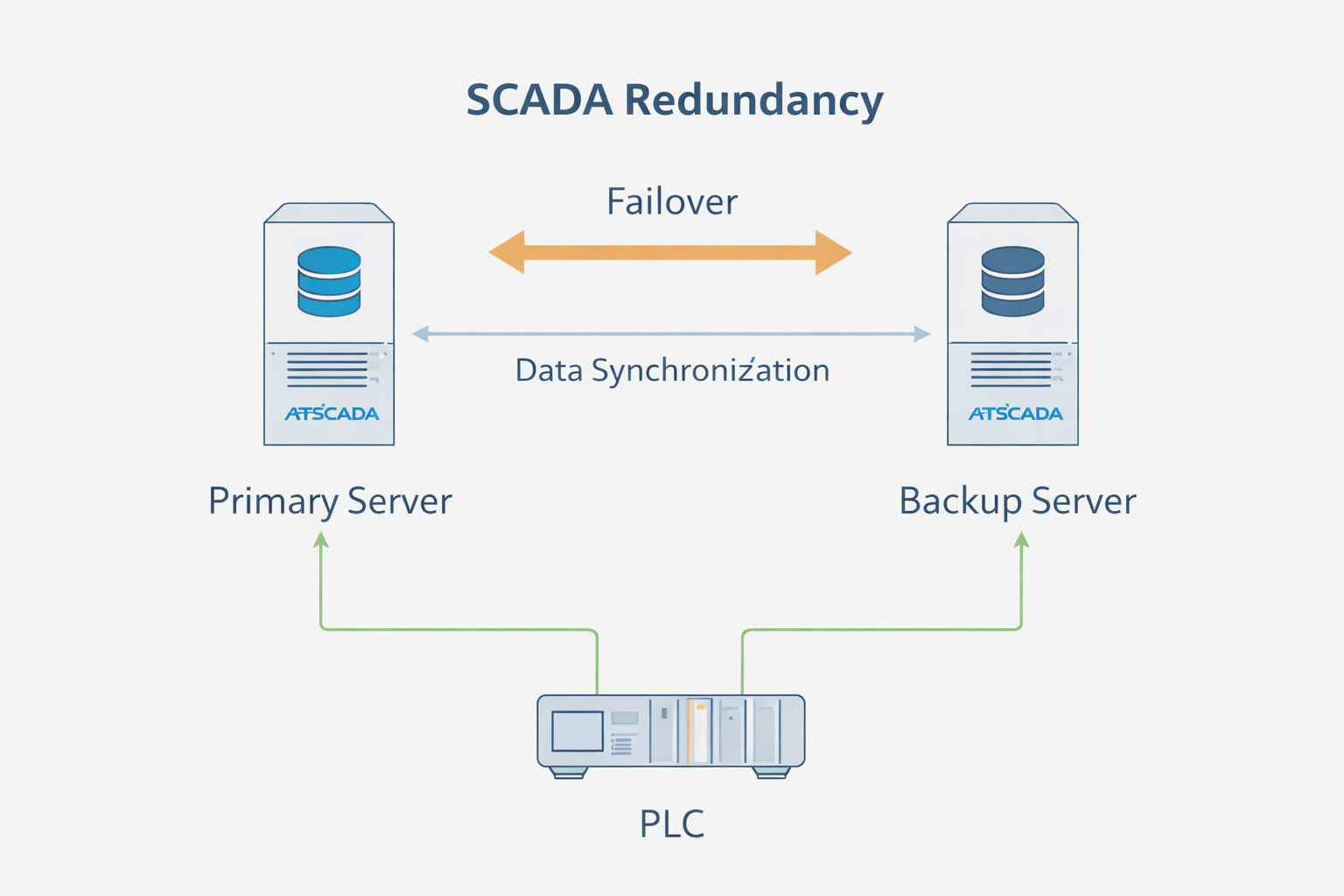
Core Architecture of SCADA Redundancy with ATSCADA
ATSCADA supports a robust redundancy architecture designed for industrial environments that require high availability ,following a typical SCADA system configuration.
Dual Server Configuration
At the heart of the system is a dual-server setup. One server operates as the main controller, while the other remains synchronized and ready to replace it instantly.
Moreover, both servers constantly exchange status information. Therefore, the system can detect failures in real time and respond immediately.
Data Synchronization Layer
Data consistency is critical in any SCADA Redundancy system. ATSCADA ensures that:
- Real-time operational data is mirrored between servers
- Historical data is continuously updated
- System states remain consistent across all nodes
Because of this, switching between servers does not result in data loss or inconsistencies.
Communication Infrastructure
The redundancy system also depends on reliable communication between components. ATSCADA integrates with:
- Industrial protocols via OPC servers
- Device communication through ATDriver
- Stable network infrastructure within LAN or industrial networks
In addition, the system can duplicate communication paths to further enhance resilience.
Automatic Failover Mechanism
One of the most critical features is automatic failover. When the system detects a failure:
- The backup server is activated instantly
- Control is transferred seamlessly
- Monitoring continues without interruption
As a result, operators may not even notice that a failure has occurred.
Key Features of SCADA Redundancy with ATSCADA
Continuous Operation
The primary benefit of SCADA Redundancy is uninterrupted operation. Even during hardware or software failures, the system continues to function normally.
Real-Time Monitoring Stability
With synchronized servers, data remains consistent across the system. Therefore, operators always have access to accurate and up-to-date information.
Intelligent Alarm Handling
ATSCADA provides advanced alarm systems that continue functioning even during failover events. This ensures that:
- Critical alerts are not missed
- Notifications are delivered in real time
- Operators can respond quickly to issues
Flexible System Expansion
You can scale redundant systems as needed. In addition, you can integrate new servers or devices without disrupting existing operations.
Benefits of Implementing SCADA Redundancy
Increased Reliability
By removing single points of failure, SCADA Redundancy significantly enhances system reliability. This is especially important in industries where downtime is unacceptable.
Data Integrity and Protection
The system duplicates and synchronizes all data. As a result, it minimizes the risk of data loss, even during unexpected failures.
High Availability
Redundant systems are designed to maximize uptime. Therefore, they are ideal for mission-critical applications that require continuous monitoring.
Reduced Operational Risk
System failures can lead to safety hazards or production losses. However, redundancy helps mitigate these risks by ensuring stable operation at all times.
Practical Applications of SCADA Redundancy
SCADA Redundancy is widely used across various industries, including:
- Power generation and electrical distribution systems
- Water and wastewater treatment facilities
- Oil and gas production and transportation
- Manufacturing and industrial automation systems
In these environments, system availability is critical, and even minor disruptions can have significant consequences.
Best Practices for Deploying SCADA Redundancy
To achieve optimal performance, consider the following recommendations:
Use Reliable Hardware
Both primary and backup servers should meet high-performance and reliability standards.
Ensure Network Stability
A stable and secure communication network is essential for synchronization and failover operations.
Perform Regular Testing
You should test failover mechanisms periodically to ensure they function properly under real conditions.
Monitor System Health
Continuous monitoring helps detect potential issues before they become critical.
Plan for Scalability
Design the system with future expansion in mind to accommodate additional devices or servers.
Conclusion
SCADA Redundancy with ATSCADA provides a powerful solution for ensuring high availability in industrial automation systems. By combining dual-server architecture, real-time synchronization, and automatic failover, it delivers continuous operation and reliable performance.
For organizations that depend on uninterrupted monitoring and control, implementing SCADA Redundancy is not just an option—it is a necessity for long-term efficiency and operational stability.
In contrast, smaller systems may rely on a standalone SCADA network where simplicity and lower cost are prioritized over high availability.
ATSCADA - Providing ATSCADA software - The monitoring and data acquisition control system is the appropriate choice for integrated system projects, IoT, smart city projects, agriculture 4.0... Is trusted by many customers.
Related posts
SCADA and IoT : Modern Industry 4.0
Industry 4.0 is creating a major transformation in the way businesses operate and manufacture. The [...]
Apr
Xu hướng ứng dụng hệ thống scada trong công nghiệp
Các hoạt động sản xuất công nghiệp ngày nay càng cao đòi hỏi nhiều tiêu [...]
Dec
Everything You Need to Know About SCADA Systems
A SCADA Systems is a combination of hardware devices and software that enables remote monitoring [...]
Dec
SCADA Security on Cloud – Securing ATSCADA Cloud Systems
Cloud SCADA, also known as IoT/IIoT-based SCADA, represents a natural evolution of traditional SCADA systems [...]
Nov
SCADA Software Architecture Overview
The SCADA Software architecture is a combination of two main parts: execution software (runtime software) [...]
Jan
Understanding PLC Siemens in SCADA Systems
Siemens PLC, or PLC in general, may be unfamiliar terms for those outside the automation [...]
Jan