
SCADA Basics
Everything You Need to Know About SCADA Systems
A SCADA Systems is a combination of hardware devices and software that enables remote monitoring and control of an entire factory or industrial plant. This technology plays a key role in modern industrial automation, helping businesses manage production processes more efficiently and safely.
In this article from ATSCADA Lab, we will explore everything you need to know about a SCADA Systems, including its definition, architecture, SCADA software, and key benefits in real-world industrial applications. For more beginner-friendly guides, visit our SCADA Basics section.
What Is a SCADA Systems?
A SCADA Systems (Supervisory Control and Data Acquisition) is an industrial automation system that integrates hardware devices and monitoring software to support plant management and operational control.
To better understand the SCADA systems definition, it is important to explore how SCADA works in real industrial environments.
A SCADA Systems helps managers and engineers perform essential tasks such as:
- Monitoring and controlling industrial processes on-site or remotely.
- Collecting, tracking, and processing real-time operational data.
- Interacting directly with industrial devices such as sensors, valves, pumps, motors, and controllers through HMI (Human-Machine Interface) software.
- Automatically recording events and storing operational history in log files for analysis and reporting
SCADA Systems Architecture
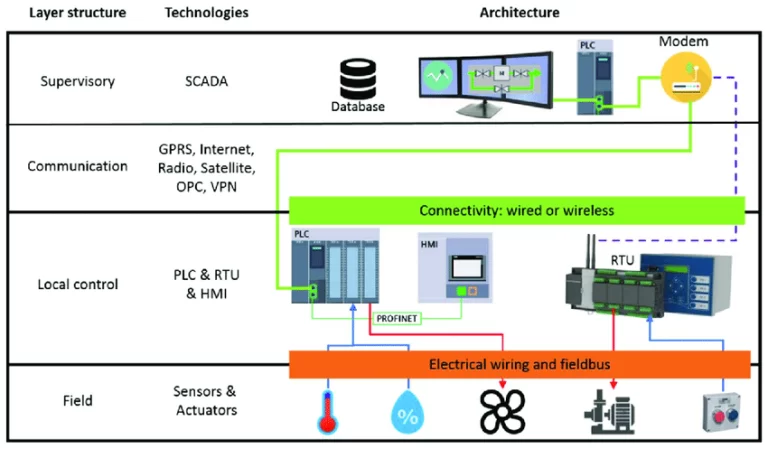
A typical SCADA Systems architecture consists of several key layers that work together to ensure smooth industrial monitoring and control.
A well-designed SCADA software architecture helps ensure stable monitoring, control, and data processing across industrial systems.
Field Devices (Sensors and Instrumentation)
Field devices include signal converters, sensors, motorized valves, valve controllers, and other industrial measurement equipment. These devices are responsible for collecting important operational parameters directly from the field.
Data Acquisition Layer (RTU and PLC)
The intermediate data acquisition station includes two main device types: RTUs and PLCs.
- RTU (Remote Terminal Unit): Data collected from sensors is converted into usable information and transmitted to the central monitoring station. This conversion process is performed through the RTU’s microprocessor.
- PLC (Programmable Logic Controller): A PLC acts as the communication bridge between users and sensors. It plays a critical role in controlling and regulating industrial equipment as well as production processes.
Communication System
The communication system includes telecommunications devices, industrial communication networks, and multiplexing/conversion equipment. Its main function is to transmit field-level data to control units and SCADA servers.
Control and Monitoring Level (SCADA Software and HMI)
The control and monitoring layer includes servers running SCADA software and HMI interface displays. SCADA software collects data transmitted from PLC and RTU systems, then sends control commands back to field equipment.
In addition, the SCADA Systems processes, distributes, and visualizes data through the HMI system, which connects to a network of devices such as HMI terminals, end-user computers, and SCADA servers.
What Is SCADA Software?
Simply put, SCADA software is one of the most important components of a SCADA Systems. It is mainly used to design, deploy, and manage industrial monitoring and control systems.
SCADA software enables engineers to build graphical dashboards, monitor real-time data, manage alarms, generate reports, and control industrial processes remotely.
ATSCADA – A Vietnamese SCADA Software Solution
ATSCADA is a Vietnamese SCADA software solution developed by the expert engineers at ATSCADA Lab. Designed for industrial monitoring and control, this platform has successfully addressed many complex challenges across a wide range of industrial systems. As a result, businesses can improve productivity, enhance operational efficiency, and strengthen overall system reliability.
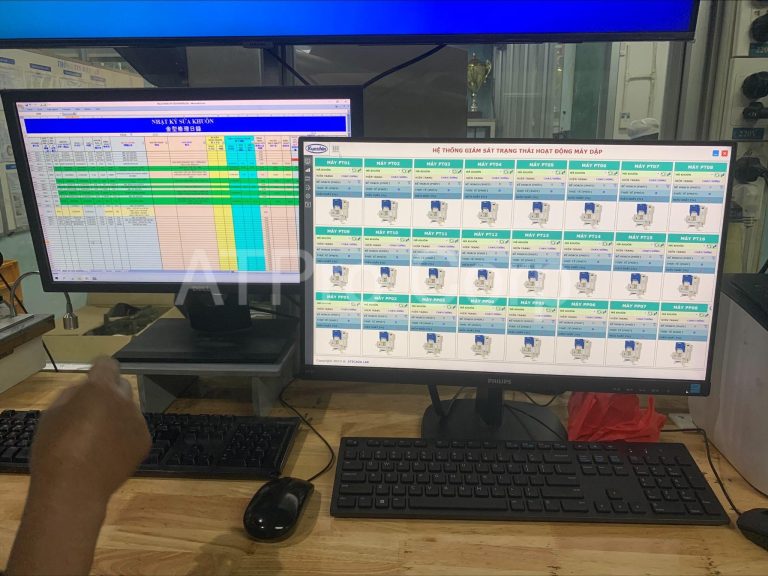
Key Advantages of ATSCADA SCADA Software
No License Cost for the Development Environment
There is no need to pay for a design license because the free version of Visual Studio already provides powerful features that are comparable to many SCADA design platforms on the market.
High-Level Programming Languages
ATSCADA supports advanced programming languages such as C# and Visual Basic, which are close to natural language. This allows automation engineers and IT professionals to learn and develop SCADA applications more easily.
Because these languages are widely used in the software industry, it is also easy to search for solutions through Google or technology forums whenever technical issues arise.
Integration with Third-Party Software Modules
ATSCADA is developed in the Visual Studio environment, which offers a large programming ecosystem. Many companies build specialized modules on this platform, such as:
- Reporting tools
- Data visualization and charting modules
- AI-based forecasting systems
As a result, users do not need to rebuild these modules from scratch, and it is easier to integrate third-party components into the SCADA Systems.
.NET Platform for Distributed Applications
Visual Studio .NET, developed by Microsoft, is built on a distributed system foundation. It is well known for component-oriented, service-oriented, and object-oriented programming technologies.
WCF (Windows Communication Foundation) is a popular technology used to solve distributed software challenges. ATSCADA inherits these strengths, making it a strong SCADA software solution for managing distributed SCADA Systems environments.
What Are the Benefits of a SCADA Systems?
Today, SCADA cybersecurity is becoming a critical factor, especially for cloud-based monitoring platforms.
Implementing a SCADA Systems in industrial operations provides many valuable benefits for businesses and manufacturing facilities, including:
- Automating industrial processes to increase efficiency and reduce human intervention.
- Continuously monitoring equipment and production lines, helping detect failures early and optimize performance.
- Providing accurate operational data that helps managers improve productivity and enhance technical performance.
- Enabling remote monitoring and control, allowing managers to track and respond anytime, anywhere using smartphones, laptops, or PCs.
- Improving system safety and reducing cybersecurity risks in industrial environments.
- Reducing labor and maintenance costs, since fewer personnel are required to monitor equipment across multiple distributed factories, and travel expenses for remote maintenance are significantly minimized.
Conclusion
Above is a complete overview of SCADA systems that ATSCADA Lab would like to share with readers. We hope this article has provided you with valuable and useful information. Thank you for taking the time to follow along.
If you are looking for a SCADA systems that best fits your business operations, please contact our hotline so ATSCADA Lab can provide you with detailed and completely free consultation.
ATSCADA - Providing ATSCADA software - The monitoring and data acquisition control system is the appropriate choice for integrated system projects, IoT, smart city projects, agriculture 4.0... Is trusted by many customers.
Related posts
SCADA and IoT : Modern Industry 4.0
Industry 4.0 is creating a major transformation in the way businesses operate and manufacture. The [...]
Apr
ALL ABOUT SCADA SYSTEM
The SCADA system is the combination of hardware devices and software that allows monitoring and [...]
Oct
SCADA – IoT: Công Nghệ Bổ Sung Cho Công Nghiệp 4.0 Hiện Đại
Công nghiệp 4.0 đang tạo ra sự thay đổi lớn trong cách các doanh nghiệp [...]
Sep
Xu hướng ứng dụng hệ thống scada trong công nghiệp
Các hoạt động sản xuất công nghiệp ngày nay càng cao đòi hỏi nhiều tiêu [...]
Dec
SCADA Security on Cloud – Securing ATSCADA Cloud Systems
Phan Duy Anh, Master’s Degree in Automation and Control, CEO of ATSCADA Lab Cloud SCADA, [...]
Nov
SCADA System Software Architecture Overview
The SCADA System Software architecture is a combination of two main parts: execution software (runtime [...]
Jan