
Other SCADA Software
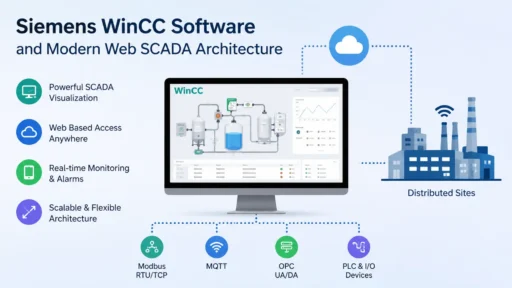
Siemens WinCC Software and Modern Web SCADA Architecture
Siemens WinCC Software has remained one of the most recognized SCADA platforms in industrial automation for many years.
The platform is widely used in:
• Manufacturing plants
• Energy infrastructure
• Water treatment facilities
• Process industries
• Large scale industrial environments
One reason for the long term popularity of Siemens WinCC Software is its strong integration with the Siemens industrial ecosystem.
Many factories operating Siemens PLC systems, industrial communication networks, and enterprise automation infrastructure continue using WinCC because of its stability and centralized monitoring capabilities.
For many industrial organizations, the platform continues to provide reliable SCADA visualization and supervisory control functionality for large scale industrial operations.
However, industrial environments are changing much faster than before.
Modern factories increasingly require:
• Remote monitoring
• Browser based dashboards
• Mobile accessibility
• Cloud integration
• Distributed industrial supervision
• Scalable industrial communication
As Industry 4.0 adoption continues growing, many businesses are beginning to evaluate how traditional deployment models compare with other modern SCADA platforms for current industrial requirements.
This is one reason why flexible Web Based SCADA architecture is becoming increasingly important.
The Strengths of Siemens WinCC Software
Siemens WinCC Software continues to remain a powerful enterprise level SCADA platform for several important reasons.
The platform offers:
• Strong industrial reliability
• Advanced HMI visualization
• Deep Siemens integration
• Enterprise level infrastructure support
• Centralized supervisory control
• Long term industrial deployment stability
For facilities already operating inside the Siemens ecosystem, the platform can provide strong consistency across industrial automation layers.
This is particularly valuable in:
• Large manufacturing facilities
• Enterprise industrial operations
• Centralized monitoring environments
• Long term infrastructure projects
The platform also supports advanced visualization capabilities for industrial process supervision and operational management.
Because of this, Siemens WinCC Software continues to play a major role across many industrial sectors worldwide.
The Challenges of Traditional SCADA Deployment
Although enterprise SCADA platforms provide strong industrial capabilities, modern industrial environments are creating new deployment challenges.
Many industrial operations today no longer function entirely from a single centralized control room.
Instead, businesses increasingly require:
• Multi site monitoring
• Remote engineering access
• Cloud connected monitoring
• Realtime mobile visibility
• Distributed production supervision
• Scalable industrial communication
In these environments, traditional desktop focused SCADA deployment models can sometimes become more difficult to scale efficiently, especially when businesses need remote visibility across multiple sites. This is also why many organizations compare Siemens WinCC with VTScada SCADA Software when evaluating remote monitoring, alarm visibility, and distributed SCADA operation.
Some industrial projects may experience challenges involving:
• Higher infrastructure dependency
• Complex client deployment
• Remote accessibility limitations
• Increasing maintenance overhead
• More complicated engineering workflows
As industrial systems continue expanding across multiple locations, maintaining distributed local SCADA workstations can gradually increase operational complexity.
Because of this, many organizations are beginning to prioritize more flexible Web Based SCADA deployment strategies.

Why Web Based SCADA Systems Are Growing
Modern industrial monitoring is increasingly moving toward web oriented architecture.
Many factories today require:
• Browser based monitoring
• Realtime remote access
• Centralized dashboards
• Mobile alarm systems
• Cloud connected visibility
• Simplified multi site supervision
Web Based SCADA systems help reduce dependency on local workstation deployment while improving operational accessibility across distributed industrial environments.
This deployment approach can simplify:
• Monitoring expansion
• Remote supervision
• Industrial data accessibility
• Long term scalability
As industrial communication systems become more complex, deployment flexibility becomes increasingly valuable for modern industrial projects.
Flexible Industrial Communication in Modern SCADA Systems
Modern industrial environments often contain mixed communication infrastructure involving:
• Legacy PLC systems
• Modbus RTU devices
• RS485 communication
• Industrial Ethernet
• MQTT enabled devices
• Cloud connected gateways
Because of this, many businesses are searching for SCADA platforms capable of supporting flexible industrial integration without introducing excessive deployment complexity.
ATSCADA is one example of a modern SCADA platform developed around scalable Web Based SCADA architecture and flexible industrial communication.
The platform supports:
• Web SCADA deployment
• MQTT communication
• Modbus RTU TCP
• OPC connectivity
• Mobile monitoring
• Realtime industrial dashboards
• Industrial alarm systems
• Multi site supervision
Rather than focusing entirely on heavily centralized infrastructure, the architecture is designed to support practical deployment workflows across distributed industrial environments.
For some industrial projects, this deployment model can help simplify:
• Remote monitoring expansion
• Mixed protocol integration
• Distributed industrial supervision
• Long term monitoring scalability
This type of flexible architecture is becoming increasingly relevant for factories requiring scalable monitoring systems while maintaining practical deployment and maintenance workflows.
Siemens WinCC Software and Modern Industry 4.0 Requirements
Siemens WinCC Software continues to remain highly important in enterprise industrial automation environments.
At the same time, industrial monitoring system requirements are continuing to evolve toward:
• Web accessibility
• Cloud integration
• Realtime remote visibility
• Flexible communication
• Distributed industrial monitoring
• Scalable deployment architecture
Because of these changes, many businesses are now evaluating not only industrial reliability, but also deployment flexibility and long-term scalability when selecting SCADA systems. In many SCADA comparison projects, AVEVA Wonderware SCADA Software is often reviewed alongside Siemens WinCC because both platforms are widely associated with large-scale industrial visualization, alarm management, and supervisory control.
This transition is influencing the growth of more flexible Web Based SCADA architectures across modern industrial environments.
Conclusion
Industrial automation is becoming more connected, distributed, and data oriented than ever before.
Platforms such as Siemens WinCC Software continue providing strong enterprise level monitoring capabilities for large industrial infrastructure environments.
At the same time, many modern industrial projects are increasingly prioritizing:
• Web based accessibility
• Flexible deployment
• Scalable communication
• Simplified monitoring expansion
• Distributed industrial visibility
As Industry 4.0 adoption continues growing, flexible Web Based SCADA platforms such as ATSCADA are becoming increasingly suitable for industrial environments requiring practical deployment workflows, scalable communication, and modern remote monitoring capabilities.

ATSCADA - Smart SCADA Software with AI Predictor & Blockchain. ATSCADA is an advanced SCADA software platform for real-time monitoring, intelligent control, and efficient data acquisition. It is ideal for Industrial IoT (IIoT), smart cities, integrated automation systems, and Agriculture 4.0. With a built-in AI Predictor, ATSCADA enables predictive analytics to detect issues early, optimize performance, and reduce downtime. The integration of Blockchain technology ensures secure, transparent, and tamper-proof data management. Highly scalable and easy to integrate, ATSCADA is trusted by businesses to enhance productivity, strengthen cybersecurity, and accelerate digital transformation.
Related articles
N3uron SCADA and the Future of Industrial Connectivity
Industrial facilities today generate massive amounts of operational data from PLCs, RTUs, sensors, power meters, [...]
Jun
FUXA SCADA and the Limits of No-Code Industrial Projects
FUXA SCADA has gained attention in the industrial automation community because of its open-source architecture [...]
Jun
Rapid SCADA and the Challenge of Building Enterprise-Scale Industrial Applications
Rapid SCADA is a well-known open-source SCADA platform that has attracted many users around the [...]
Jun
MAPS SCADA and the Future of Industrial Software Integration
MAPS SCADA has been used in industrial environments for many years and remains a familiar [...]
Jun
Movicon.NExT and the Cost of Vendor Lock-In in Industrial Software Projects
Movicon.NExT has become a familiar name in industrial automation projects that require SCADA, HMI, alarm [...]
Jun
CIMON SCADA and the Future of Open Industrial Software Development
CIMON SCADA has been used in many industrial automation projects, particularly in manufacturing environments that [...]
Jun