
Technical Guides
SCADA Applications in Oil and Gas Industry: Improving Safety and Efficiency
The oil and gas industry operates in one of the most complex and high-risk environments in the world. From upstream exploration to downstream distribution, maintaining safety, efficiency, and real-time visibility is critical. This is where SCADA (Supervisory Control and Data Acquisition) systems play a transformative role.
In this article, we explore SCADA applications in oil and gas industry, highlighting how modern solutions like ATSCADA help companies streamline operations, reduce risks, and improve decision-making.
What is SCADA in the Oil and Gas Industry?
SCADA is a system used to monitor, control, and automate industrial processes. In oil and gas, SCADA connects remote assets such as pipelines, drilling rigs, and storage tanks into a centralized control system.
Key Functions of SCADA:
- Real-time data acquisition
- Remote monitoring and control
- Alarm management and event detection
- Data logging and reporting
- Integration with industrial devices (PLC, RTU, sensors)
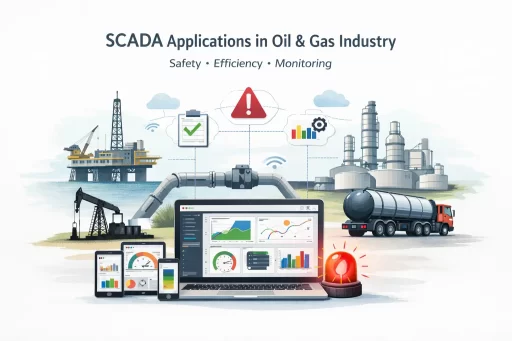
Key SCADA Applications in Oil and Gas Industry
Upstream Operations (Exploration & Production)
SCADA systems are widely used in upstream activities to monitor drilling operations and well performance.
Benefits:
- Real-time monitoring of pressure, temperature, and flow rates
- Early detection of equipment failures
- Remote well control in offshore or isolated locations
Pipeline Monitoring and Management
Pipelines are critical assets, often spanning hundreds or thousands of kilometers. SCADA ensures their safe and efficient operation.
Key Applications:
- Leak detection systems
- Flow rate monitoring
- Pressure control and anomaly detection
Why It Matters:
Pipeline failures can lead to environmental disasters and financial losses. SCADA minimizes these risks through continuous monitoring.
Midstream Storage and Transportation
SCADA helps manage storage tanks, pumping stations, and transportation systems.
Capabilities:
- Tank level monitoring
- Automated valve control
- Inventory tracking
Downstream Refining and Distribution
In refineries, SCADA systems ensure precise control over complex processes.
Key Benefits:
- Process optimization
- Energy efficiency improvement
- Safety compliance monitoring
Enhancing Safety with SCADA Systems
Safety is a top priority in the oil and gas industry. SCADA systems contribute significantly by:
- Detecting abnormal conditions in real time
- Triggering automated shutdowns
- Sending alerts to operators immediately
- Reducing human exposure to hazardous environments
Example:
If a sudden pressure drop is detected in a pipeline, SCADA can automatically isolate the affected section, preventing major incidents.
Improving Operational Efficiency
SCADA systems not only improve safety but also boost efficiency across operations.
How SCADA Improves Efficiency:
- Reduces manual intervention
- Enables predictive maintenance
- Optimizes resource usage
- Minimizes downtime
With real-time data, operators can make faster and more accurate decisions.
Role of ATSCADA in Oil and Gas Industry
Why Choose ATSCADA?
ATSCADA is a modern web-based SCADA platform designed to meet the evolving needs of industrial sectors, including oil and gas.
1. Web-Based Accessibility
Operators can monitor systems from anywhere using a web browser—no installation required.
2. Real-Time Data Visualization
ATSCADA provides intuitive dashboards inspired by SCADA web design building user-friendly industrial interfaces for better decision-making.
3. Scalable Architecture
Suitable for small installations to large-scale oil and gas operations.
4. Advanced Alarm Management
Helps detect and respond to critical issues quickly.
5. Seamless Integration
Compatible with PLCs, RTUs, and IoT devices.
ATSCADA in Practical Oil & Gas Applications
- Remote monitoring of offshore rigs
- Pipeline leak detection systems
- Tank farm automation
- Refinery process optimization
ATSCADA enables companies to transition toward digital oilfields, where data-driven insights lead to smarter operations.
Integration with Modern Technologies
Modern industrial sectors, including SCADA application in power, are rapidly evolving through Industry 4.0 technologies.
Key Integrations:
- IoT (Internet of Things): Enhanced sensor connectivity
- Cloud Computing: Remote data storage and analytics
- AI & Machine Learning: Predictive maintenance and anomaly detection
ATSCADA supports these integrations, making it future-ready for digital transformation.
Challenges in SCADA Implementation
While SCADA offers many benefits, implementation comes with challenges:
- High initial investment
- Cybersecurity concerns
- Integration with legacy systems
- Training requirements for staff
However, modern platforms like ATSCADA reduce these barriers with flexible deployment and user-friendly interfaces.
Future of SCADA in Oil and Gas
The future of SCADA in oil and gas is driven by:
- Increased automation
- Real-time analytics
- Enhanced cybersecurity
- Remote and autonomous operations
As the industry moves toward sustainability and efficiency, SCADA systems like ATSCADA will play a central role.
Conclusion
SCADA applications in oil and gas industry are essential for ensuring safety, efficiency, and operational excellence. From upstream exploration to downstream refining, SCADA systems provide the visibility and control needed to manage complex processes.
With advanced platforms like ATSCADA, companies can leverage modern technologies to optimize performance, reduce risks, and stay competitive in a rapidly evolving industry.
ATSCADA - Smart SCADA Software with AI Predictor & Blockchain. ATSCADA is an advanced SCADA software platform for real-time monitoring, intelligent control, and efficient data acquisition. It is ideal for Industrial IoT (IIoT), smart cities, integrated automation systems, and Agriculture 4.0. With a built-in AI Predictor, ATSCADA enables predictive analytics to detect issues early, optimize performance, and reduce downtime. The integration of Blockchain technology ensures secure, transparent, and tamper-proof data management. Highly scalable and easy to integrate, ATSCADA is trusted by businesses to enhance productivity, strengthen cybersecurity, and accelerate digital transformation.
Related articles
Utility SCADA Systems for Power, Water, and Infrastructure Management
In today’s rapidly evolving industrial landscape, Utility SCADA Systems play a critical role in managing [...]
Apr
Cost of a SCADA System: Complete Pricing Guide
Understanding the Cost of a SCADA System is essential for businesses planning to implement or [...]
Apr
SCADA Software Price: Complete Cost Guide for Industrial Systems
Understanding SCADA software price is essential for any organization planning to implement or upgrade industrial [...]
Apr
Cheap SCADA Software for Small and Medium Businesses
In today’s competitive industrial landscape, small and medium businesses (SMBs) are under constant pressure to [...]
Apr
Low Cost SCADA Solutions for Efficient Industrial Automation
In today’s competitive industrial landscape, companies are under constant pressure to improve efficiency while minimizing [...]
Apr
Ignition SCADA and AI: Integrating Intelligent Automation into Modern SCADA Systems
In modern industrial environments, Ignition SCADA and AI are increasingly combined to move beyond traditional [...]
Apr