
Technical Guides
Free Open SCADA: Building Flexible and Cost-Effective Industrial Automation Systems
Industrial automation is rapidly evolving, and businesses are actively searching for cost-effective yet powerful solutions. This is where free open SCADA systems come into play. They provide a flexible foundation for monitoring and controlling industrial processes without the high licensing costs of traditional platforms.
However, while free open SCADA tools offer accessibility, they often come with limitations in scalability, support, and integration. This is where platforms like ATSCADA bridge the gap—combining the openness of free solutions with enterprise-grade performance.
In this guide, we’ll explore what a free open SCADA system is, its benefits, limitations, and how ATSCADA enhances its capabilities for real-world industrial applications.
What Is a Free Open SCADA System?
A free open SCADA system refers to an open SCADA system that is:
- Available at no cost (or with a free version)
- Built on open standards or open-source architecture
- Designed for flexibility and integration
Unlike proprietary SCADA systems, these platforms allow engineers to customize features, integrate multiple protocols, and avoid vendor lock-in.
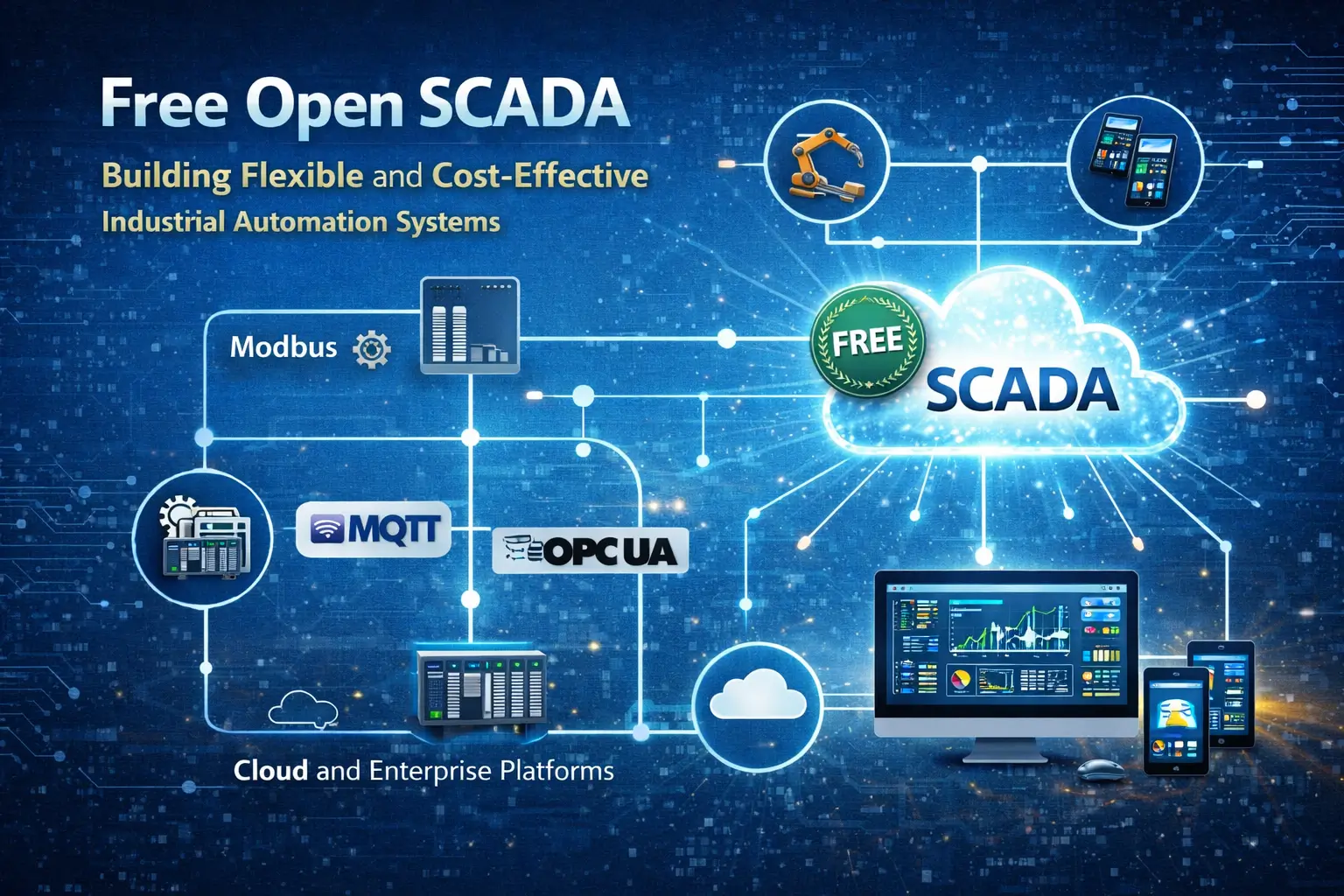
Open Communication Protocols
Free open SCADA systems typically support:
- OPC UA
- Modbus
- MQTT
Customizable Architecture
Users can modify or extend functionalities depending on project needs.
Community-Driven Development
Many free SCADA platforms evolve through community contributions rather than centralized vendors.
Why Businesses Are Adopting Free Open SCADA
Lower Initial Investment
The most obvious advantage of a free open SCADA system is cost savings. Companies can deploy basic monitoring systems without significant upfront expenses.
Flexibility and Independence
Organizations are not tied to a single vendor. This allows:
- Easier system upgrades
- Integration with diverse hardware
- Long-term adaptability
Faster Experimentation
Free platforms are ideal for:
- Prototyping
- Testing automation concepts
- Training engineers
Limitations of Free Open SCADA Systems
Despite their benefits, free open SCADA solutions are not always suitable for large-scale industrial environments.
Limited Technical Support
Most free systems rely on community forums, which may not provide timely or reliable support.
Scalability Challenges
As systems grow, performance issues may arise due to:
- Lack of optimized architecture
- Limited data handling capabilities
Security Risks
Without enterprise-grade security features, systems may be vulnerable to cyber threats.
Integration Complexity
Connecting multiple devices and platforms often requires significant manual configuration.
ATSCADA: Enhancing Free Open SCADA Capabilities
ATSCADA is designed to overcome the limitations of traditional free open SCADA systems while preserving their flexibility.
A Modern Open Architecture
ATSCADA supports open standards and multi-protocol communication, enabling seamless integration across industrial environments.
Web-Based SCADA Platform
Unlike many free tools, ATSCADA provides:
- Browser-based access
- Remote monitoring
- Cross-device compatibility
Scalable System Design
ATSCADA allows systems to grow without requiring complete redesigns, making it ideal for both small and large deployments.
Built-In Security Features
Security is integrated into the platform, including:
- Role-based access control
- Secure communication protocols
- Data protection mechanisms
Key Features of an Effective Free Open SCADA Solution
To maximize the value of a free open SCADA system, certain capabilities are essential.
Real-Time Data Monitoring
Operators must be able to visualize system performance instantly and respond to changes.
Intelligent Alarm Management
Automated alerts help detect anomalies early and reduce downtime.
Historical Data Analysis
Data logging enables:
- Performance optimization
- Predictive maintenance
- Trend analysis
Remote Access and Control
Modern SCADA systems should allow users to manage operations from anywhere.
Integration with PLC and Industrial Systems
A critical requirement for any platform is seamless integration with PLCs.
ATSCADA simplifies this process by supporting multiple PLC brands and communication standards, reducing deployment complexity.
Implementation Strategy for Free Open SCADA
Deploying a system requires careful planning.
Step 1: Define System Requirements
Identify:
- Monitoring needs
- Control processes
- Data requirements
Step 2: Choose the Right Platform
Select a solution that balances openness with reliability or offers a practical download open SCADA option —such as ATSCADA.
Step 3: Design the Architecture
Ensure compatibility between:
- Devices
- Communication protocols
- Software systems
Step 4: Deploy and Test
Implement the system gradually and validate performance.
Step 5: Optimize and Scale
Continuously improve system efficiency and prepare for expansion.
Real-World Benefits of Free Open SCADA with ATSCADA
Cost Efficiency
Reduce both initial and long-term operational costs.
Improved Operational Visibility
Gain real-time insights into industrial processes.
Faster Decision-Making
Data-driven insights enable quicker and more accurate decisions.
Future-Proof Scalability
Adapt to new technologies without major system overhauls.
The Future of Free Open SCADA Systems
The evolution is closely tied to emerging technologies:
- Industrial IoT (IIoT)
- Cloud computing
- Artificial intelligence
- Edge computing
ATSCADA continues to integrate these innovations, ensuring that businesses can stay competitive in a rapidly changing industrial landscape.
Conclusion
A free open SCADA system is an excellent starting point for organizations seeking flexible and cost-effective automation solutions. However, to achieve long-term success, businesses need more than just free tools—they need scalability, security, and reliability.
ATSCADA delivers the best of both worlds: the openness of free SCADA systems combined with the robustness of an enterprise-grade platform.
If you’re looking to build a modern, scalable, and future-ready industrial control system, ATSCADA is the ideal solution to elevate your free open SCADA strategy.

ATSCADA - Smart SCADA Software with AI Predictor & Blockchain. ATSCADA is an advanced SCADA software platform for real-time monitoring, intelligent control, and efficient data acquisition. It is ideal for Industrial IoT (IIoT), smart cities, integrated automation systems, and Agriculture 4.0. With a built-in AI Predictor, ATSCADA enables predictive analytics to detect issues early, optimize performance, and reduce downtime. The integration of Blockchain technology ensures secure, transparent, and tamper-proof data management. Highly scalable and easy to integrate, ATSCADA is trusted by businesses to enhance productivity, strengthen cybersecurity, and accelerate digital transformation.
Related articles
Utility SCADA Systems for Power, Water, and Infrastructure Management
In today’s rapidly evolving industrial landscape, Utility SCADA Systems play a critical role in managing [...]
Apr
Cost of a SCADA System: Complete Pricing Guide
Understanding the Cost of a SCADA System is essential for businesses planning to implement or [...]
Apr
SCADA Software Price: Complete Cost Guide for Industrial Systems
Understanding SCADA software price is essential for any organization planning to implement or upgrade industrial [...]
Apr
Cheap SCADA Software for Small and Medium Businesses
In today’s competitive industrial landscape, small and medium businesses (SMBs) are under constant pressure to [...]
Apr
Low Cost SCADA Solutions for Efficient Industrial Automation
In today’s competitive industrial landscape, companies are under constant pressure to improve efficiency while minimizing [...]
Apr
Ignition SCADA and AI: Integrating Intelligent Automation into Modern SCADA Systems
In modern industrial environments, Ignition SCADA and AI are increasingly combined to move beyond traditional [...]
Apr