
Technical Guides
SCADA Traffic Lights: Smart Traffic Management and Real-Time Control Systems
Urban congestion is a growing challenge in modern cities. Traditional traffic light systems often fail to adapt to real-time conditions, leading to inefficiencies, delays, and increased emissions. This is where SCADA Traffic Lights come into play.
SCADA (Supervisory Control and Data Acquisition) technology transforms conventional traffic systems into intelligent, data-driven networks. By integrating real-time monitoring, automation, and analytics, SCADA enables cities to optimize traffic flow and improve safety.
In this guide, we explore how SCADA Traffic Lights work, their benefits, and how ATSCADA plays a key role in building next-generation smart traffic systems.
What Are SCADA Traffic Lights?
SCADA Traffic Lights refer to traffic control systems that use SCADA technology to monitor, manage, and automate signal operations across intersections.
Key Components
- Sensors & Detectors: Collect real-time traffic data (vehicle count, speed, congestion levels)
- RTUs/PLCs: Process data locally at intersections
- SCADA Software: Centralized platform for monitoring and control
- Communication Network: Enables data exchange between field devices and control centers
- Human-Machine Interface (HMI): Visual dashboards for operators
Unlike traditional fixed-timing signals, SCADA-based systems dynamically adjust signal timings based on real-world conditions.
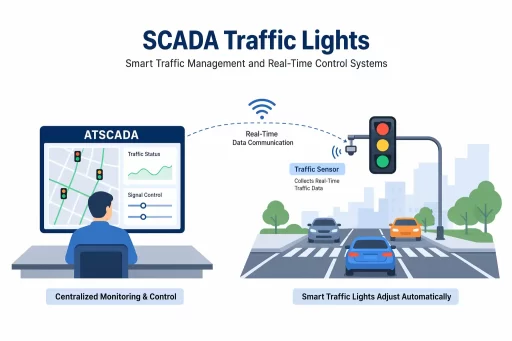
How SCADA Traffic Lights Work
Real-Time Data Collection
Traffic sensors continuously gather data such as:
- Vehicle density
- Waiting time at intersections
- Traffic flow direction
Centralized Monitoring
All data is transmitted to a central SCADA system, where operators can:
- View live traffic conditions
- Detect congestion or incidents
- Monitor system performance
Intelligent Control
SCADA systems automatically adjust traffic signals by:
- Extending green lights in high-traffic directions
- Reducing idle time at low-traffic lanes
- Coordinating multiple intersections for smooth flow
Alerts and Automation
If abnormalities occur (e.g., signal failure, heavy congestion), the system can:
- Trigger alarms
- Notify operators
- Execute predefined control strategies
Benefits of SCADA Traffic Lights
1. Improved Traffic Flow
By adapting to real-time conditions, SCADA systems reduce congestion and travel time significantly.
2. Enhanced Road Safety
Automated monitoring helps prevent accidents by ensuring optimal signal timing and quick response to incidents.
3. Reduced Environmental Impact
Efficient traffic flow minimizes fuel consumption and emissions, supporting sustainable urban development.
4. Centralized Control
Traffic authorities can manage multiple intersections from a single platform, improving operational efficiency.
5. Scalability
SCADA Traffic Light systems can easily expand as cities grow, integrating new intersections and technologies.
SCADA Traffic Lights in Smart Cities
Smart cities rely heavily on intelligent infrastructure. SCADA Traffic Lights are a critical component of this ecosystem.
Integration with Smart Technologies
- IoT devices for advanced sensing
- AI-based traffic prediction
- Cloud-based data analytics
Real-World Applications
- Urban traffic optimization
- Emergency vehicle prioritization
- Public transport signal priority
- Event-based traffic management
SCADA enables cities to move from reactive to proactive traffic control, including applications like SCADA bus systems real-time monitoring for public transportation optimization.
The Role of ATSCADA in Traffic Light Systems
ATSCADA provides a modern, flexible SCADA platform tailored for smart infrastructure applications, including traffic management.
Key Advantages of ATSCADA
Web-Based Architecture
ATSCADA allows operators to monitor and control traffic systems from any device with a web browser—no complex installations required.
Real-Time Visualization
Interactive dashboards provide:
- Live traffic data
- Signal status monitoring
- Historical trend analysis
Customizable Control Logic
Traffic engineers can design and modify control strategies easily to suit different urban scenarios.
High Scalability
Whether managing a small town or a large metropolitan network, ATSCADA scales efficiently.
Integration Capabilities
ATSCADA supports integration with:
- PLCs and RTUs
- IoT devices
- Third-party systems
Use Case: SCADA Traffic Lights with ATSCADA
Imagine a busy urban intersection during peak hours.
Without SCADA
- Fixed signal timing
- Long waiting times
- Traffic congestion builds up quickly
With SCADA Traffic Lights (ATSCADA)
- Sensors detect increased traffic flow
- ATSCADA adjusts green light duration dynamically
- Adjacent intersections are synchronized
- Traffic flows smoothly with minimal delay
This real-time adaptability is what makes SCADA systems essential for modern cities.
Challenges and Considerations
While SCADA Traffic Lights offer many benefits, there are challenges to consider:
Initial Investment
Deploying SCADA infrastructure requires upfront costs for hardware, software, and communication systems.
Cybersecurity
As systems become more connected, protecting them from cyber threats is critical.
Maintenance
Regular updates and system maintenance are necessary to ensure reliability.
However, platforms like ATSCADA address these challenges with secure, scalable, and user-friendly solutions.
Future Trends in SCADA Traffic Lights
The future of SCADA Traffic Lights is closely tied to emerging technologies:
AI and Machine Learning
Predictive algorithms will optimize traffic patterns based on historical and real-time data.
Edge Computing
Processing data closer to the source reduces latency and improves responsiveness.
Autonomous Vehicles Integration
SCADA systems will communicate directly with vehicles for smarter traffic coordination.
Cloud-Based SCADA
Platforms like ATSCADA will continue to evolve with cloud capabilities, enabling greater flexibility and scalability.
Conclusion
SCADA Traffic Lights represent a major leap forward in urban traffic management. By combining real-time data, automation, and intelligent control, these systems significantly improve efficiency, safety, and sustainability.
With powerful platforms like ATSCADA, cities can implement scalable and future-ready traffic solutions that adapt to ever-changing conditions.
As urban populations continue to grow, investing in SCADA-based traffic systems and broader applications for SCADA is no longer optional—it’s essential for building smarter, more livable cities.
👉 Learn More about Scada system

ATSCADA - Smart SCADA Software with AI Predictor & Blockchain. ATSCADA is an advanced SCADA software platform for real-time monitoring, intelligent control, and efficient data acquisition. It is ideal for Industrial IoT (IIoT), smart cities, integrated automation systems, and Agriculture 4.0. With a built-in AI Predictor, ATSCADA enables predictive analytics to detect issues early, optimize performance, and reduce downtime. The integration of Blockchain technology ensures secure, transparent, and tamper-proof data management. Highly scalable and easy to integrate, ATSCADA is trusted by businesses to enhance productivity, strengthen cybersecurity, and accelerate digital transformation.
Related articles
Utility SCADA Systems for Power, Water, and Infrastructure Management
In today’s rapidly evolving industrial landscape, Utility SCADA Systems play a critical role in managing [...]
Apr
Cost of a SCADA System: Complete Pricing Guide
Understanding the Cost of a SCADA System is essential for businesses planning to implement or [...]
Apr
SCADA Software Price: Complete Cost Guide for Industrial Systems
Understanding SCADA software price is essential for any organization planning to implement or upgrade industrial [...]
Apr
Cheap SCADA Software for Small and Medium Businesses
In today’s competitive industrial landscape, small and medium businesses (SMBs) are under constant pressure to [...]
Apr
Low Cost SCADA Solutions for Efficient Industrial Automation
In today’s competitive industrial landscape, companies are under constant pressure to improve efficiency while minimizing [...]
Apr
Ignition SCADA and AI: Integrating Intelligent Automation into Modern SCADA Systems
In modern industrial environments, Ignition SCADA and AI are increasingly combined to move beyond traditional [...]
Apr