
Technical Guides
Open SCADA Protocol: The Backbone of Interoperable Industrial Systems
In many industrial environments, systems don’t fail because of hardware—they fail because they can’t talk to each other efficiently.
Different PLCs, sensors, and software platforms often operate in isolated ecosystems. Data becomes fragmented, integration becomes expensive, and scaling becomes a nightmare.
This is exactly where the open SCADA protocol changes the game.
Instead of forcing systems into rigid, proprietary frameworks, open protocols create a shared language—allowing machines, platforms, and applications to communicate seamlessly.
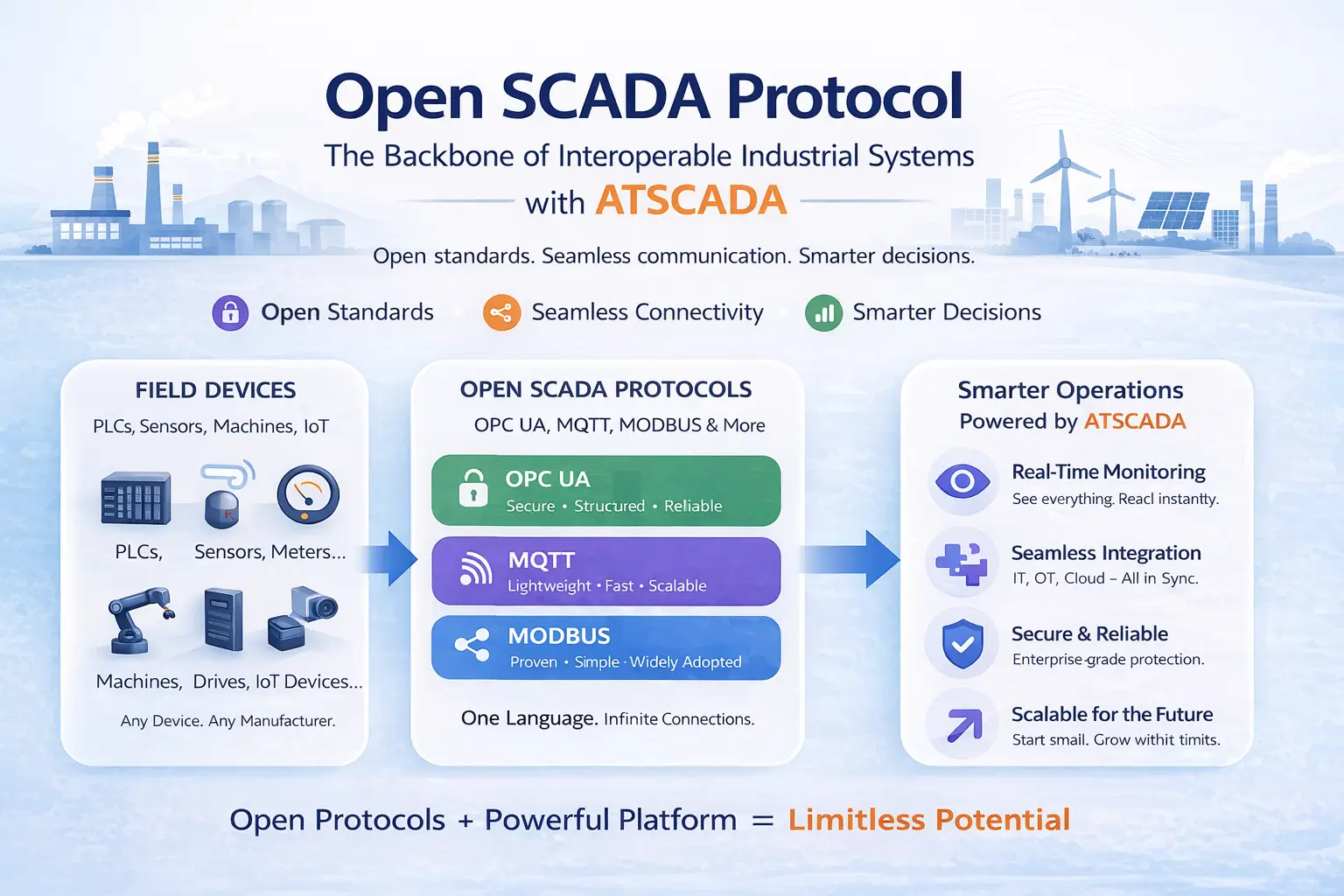
Open SCADA Protocol Explained (Without the Buzzwords)
At its core, an open SCADA protocol is not just a technical standard—it’s a strategy.
It defines how data moves, how devices communicate, and how systems scale without friction.
Rather than locking you into one vendor, open protocols and open source SCADA platforms let you build an ecosystem where:
- Devices from different manufacturers coexist
- Systems evolve without complete redesign
- Data flows freely across layers (edge → SCADA → cloud)
Think of it as moving from a “closed island” system to a connected industrial network.
From Data Silos to Connected Systems
Traditional Approach
- Data trapped inside proprietary systems
- Limited integration options
- Expensive upgrades
With Open SCADA Protocol
- Unified data flow across systems
- Easy integration with IoT and cloud
- Scalable architecture
This shift is not just technical—it directly impacts efficiency, cost, and innovation speed.
Where ATSCADA Fits Into the Picture
Open protocols alone are not enough. You still need a platform that can orchestrate everything intelligently.
That’s where ATSCADA comes in.
Instead of replacing open SCADA protocols, ATSCADA amplifies their value.
Turning Protocols into Usable Intelligence
ATSCADA doesn’t just connect devices—it transforms communication into:
- Real-time dashboards
- Actionable insights
- Automated workflows
Bridging Legacy and Modern Systems
One of the biggest real-world challenges is mixed environments:
- Old PLCs using Modbus
- New IoT devices using MQTT
- Enterprise systems requiring API integration
ATSCADA acts as a bridge, allowing all these layers to communicate through open SCADA protocols without conflict.
Making Complexity Invisible
From the outside, a SCADA system should feel simple—even if the backend is complex.
ATSCADA abstracts protocol complexity and gives users:
- Clean visualization
- Centralized control
- Seamless user experience
The Protocols That Actually Matter (And Why)
Instead of listing protocols generically, let’s look at when and why they matter:
OPC UA – When Security and Structure Matter
- Ideal for enterprise-grade systems
- Strong data modeling and encryption
MQTT – When Speed and Scalability Matter
- Lightweight, perfect for IoT
- Efficient for remote monitoring
Modbus – When Legacy Systems Still Run the Show
- Simple and widely adopted
- Critical in brownfield environments
A Real-World Scenario
Imagine a manufacturing plant scaling from 1 line to 5 lines.
Without open SCADA protocol:
- Each expansion requires custom integration
- Data remains fragmented
- Downtime increases
With open SCADA protocol + ATSCADA:
- New devices plug into existing architecture
- Data is instantly available across the system
- Scaling becomes predictable and cost-efficient
What Most People Get Wrong About Open SCADA Protocol
Misconception 1: “Open means simple”
→ Reality: Open systems require good architecture, not just open standards
Misconception 2: “Protocols solve everything”
→ Reality: Without a platform like ATSCADA, protocols remain raw infrastructure
Misconception 3: “Security is weaker in open systems”
→ Reality: Modern open protocols (like OPC UA) are often more secure than legacy proprietary ones
Designing a Future-Proof SCADA Architecture
If you’re planning to adopt an open SCADA protocol, focus on these principles:
Think in Layers
- Device layer
- Communication layer
- SCADA platform
- Analytics / cloud
Avoid Tight Coupling
Keep systems loosely connected to allow flexibility.
Standardize Early
Choosing the right protocol early prevents costly rework later.
Use a Central Intelligence Layer
This is where ATSCADA becomes critical—turning communication into control.
The Bigger Picture: Why This Matters Long-Term
Open SCADA protocol is not just a technical upgrade—it’s a strategic shift toward open automation SCADA systems and digital resilience.
It enables:
- Faster innovation cycles
- Easier adoption of new technologies
- Better data-driven decision making
And when combined with ATSCADA, it becomes more than communication—it becomes a complete industrial intelligence system.
Conclusion
The role of an open SCADA protocol is no longer optional in modern industrial systems—it is foundational.
But protocols alone are not enough.
To truly unlock their potential, businesses need a platform that can integrate, visualize, and scale effectively.
ATSCADA delivers exactly that—turning open communication into real operational value.

ATSCADA - Smart SCADA Software with AI Predictor & Blockchain. ATSCADA is an advanced SCADA software platform for real-time monitoring, intelligent control, and efficient data acquisition. It is ideal for Industrial IoT (IIoT), smart cities, integrated automation systems, and Agriculture 4.0. With a built-in AI Predictor, ATSCADA enables predictive analytics to detect issues early, optimize performance, and reduce downtime. The integration of Blockchain technology ensures secure, transparent, and tamper-proof data management. Highly scalable and easy to integrate, ATSCADA is trusted by businesses to enhance productivity, strengthen cybersecurity, and accelerate digital transformation.
Related articles
Utility SCADA Systems for Power, Water, and Infrastructure Management
In today’s rapidly evolving industrial landscape, Utility SCADA Systems play a critical role in managing [...]
Apr
Cost of a SCADA System: Complete Pricing Guide
Understanding the Cost of a SCADA System is essential for businesses planning to implement or [...]
Apr
SCADA Software Price: Complete Cost Guide for Industrial Systems
Understanding SCADA software price is essential for any organization planning to implement or upgrade industrial [...]
Apr
Cheap SCADA Software for Small and Medium Businesses
In today’s competitive industrial landscape, small and medium businesses (SMBs) are under constant pressure to [...]
Apr
Low Cost SCADA Solutions for Efficient Industrial Automation
In today’s competitive industrial landscape, companies are under constant pressure to improve efficiency while minimizing [...]
Apr
Ignition SCADA and AI: Integrating Intelligent Automation into Modern SCADA Systems
In modern industrial environments, Ignition SCADA and AI are increasingly combined to move beyond traditional [...]
Apr