
Technical Guides
Open Automation SCADA: The Future of Flexible Industrial Control
In the era of Industry 4.0, businesses are rapidly shifting toward more flexible, scalable, and interoperable systems. One of the most important advancements in this transformation is open automation SCADA. Unlike traditional proprietary systems, open automation SCADA platforms enable seamless integration, vendor independence, and faster innovation.
ATSCADA is at the forefront of this movement, delivering a modern approach to SCADA that aligns with open automation principles while ensuring reliability and performance for industrial applications.
What Is Open Automation SCADA?
Open automation SCADA refers to supervisory control and data acquisition systems built on open standards, modular architectures, and interoperable technologies. These systems allow organizations to integrate various hardware and software components without being locked into a single vendor.
Key Characteristics
- Interoperability: Supports multiple communication protocols (OPC UA, MQTT, Modbus, etc.)
- Scalability: Easily expand systems without major redesign
- Vendor neutrality: Freedom to choose hardware and software components
- Modularity: Flexible system design with reusable components
This approach significantly reduces long-term costs and increases system adaptability.
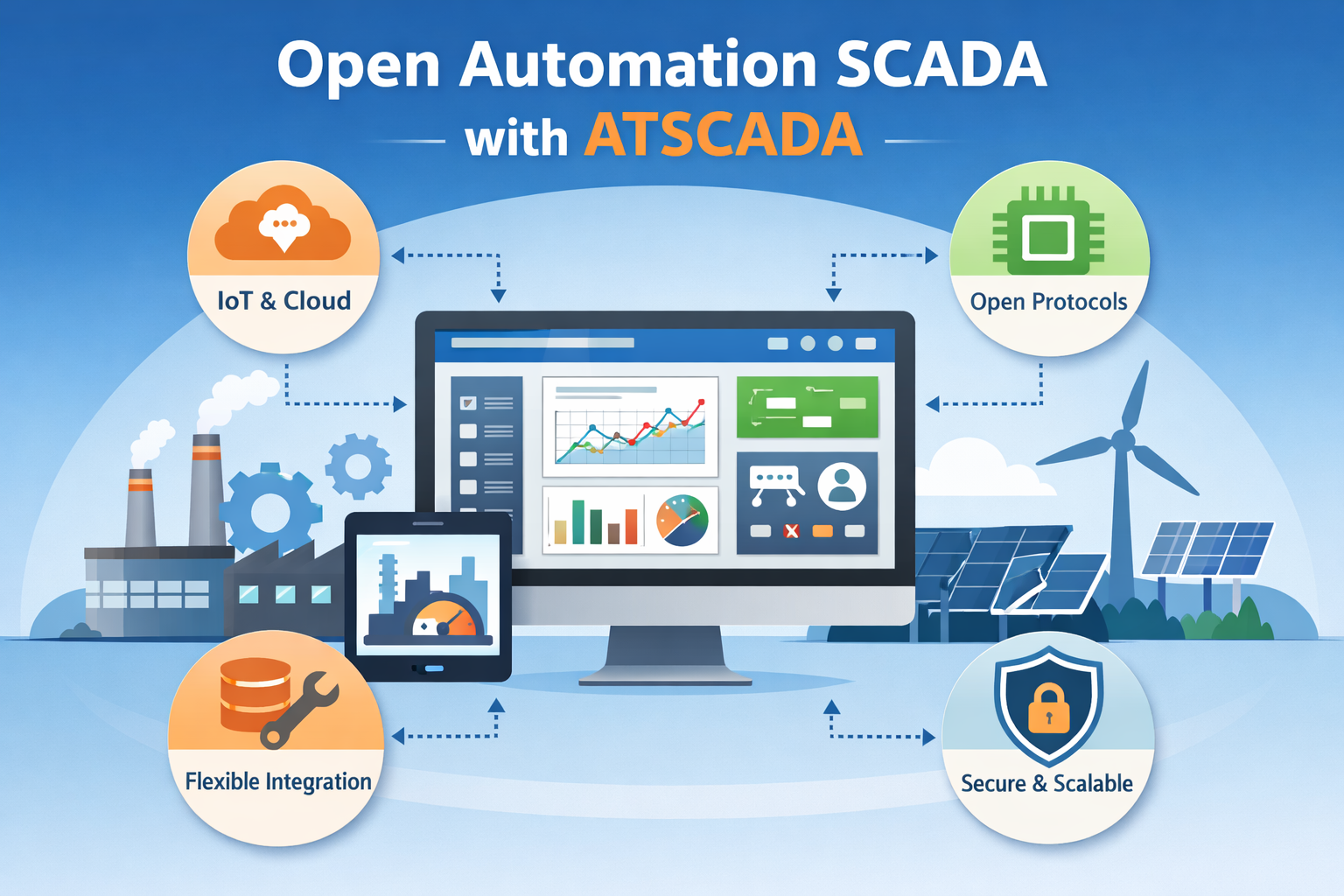
Why Open Automation SCADA Matters in Modern Industry
Industries today demand agility, data transparency, and seamless integration. Traditional SCADA systems often struggle to meet these expectations due to rigid architectures.
1. Enhanced Flexibility
Open systems allow businesses to adapt quickly to changing operational needs without replacing entire infrastructures.
2. Improved Integration
Open automation SCADA integrates easily with advanced SCADA reporting software and other systems such as:
- ERP systems
- IoT platforms
- Cloud services
- AI-driven analytics
3. Reduced Vendor Lock-in
Companies are no longer dependent on a single provider, giving them more control over system upgrades and maintenance.
4. Future-Proof Architecture
With open standards, systems remain compatible with emerging technologies.
How ATSCADA Enables Open Automation SCADA
ATSCADA is designed to fully support open automation principles while maintaining enterprise-level reliability.
Open Communication Architecture
ATSCADA supports industry-standard protocols, ensuring seamless connectivity between devices and platforms.
Modular System Design
Users can build customized SCADA solutions tailored to their specific operational requirements.
Web-Based Interface
With modern web technologies and web SCADA open source solutions, ATSCADA enables real-time monitoring from anywhere, improving accessibility and decision-making.
Advanced Data Analytics
ATSCADA transforms raw data into actionable insights, helping businesses optimize operations and predict failures.
Real-World Applications of Open Automation SCADA
Open automation SCADA is widely used across various industries due to its flexibility and scalability.
Manufacturing
- Real-time production monitoring
- Predictive maintenance
- Integration with MES and ERP systems
Energy & Utilities
- Smart grid management
- Renewable energy integration
- Remote asset monitoring
Water & Wastewater
- Automated treatment processes
- Remote monitoring of pipelines and tanks
Smart Infrastructure
- Building management systems
- Smart city applications
- IoT-based monitoring networks
Challenges and Considerations
While open automation SCADA offers numerous benefits, it also comes with certain challenges:
System Complexity
Open systems may require more expertise to design and manage effectively.
Cybersecurity Risks
Increased connectivity means stronger security measures are essential.
Standardization Issues
Not all devices fully comply with open standards, requiring careful selection.
However, with platforms like ATSCADA, these challenges are mitigated through robust architecture and security-first design.
Best Practices for Implementing Open Automation SCADA
To successfully adopt open automation SCADA, consider the following:
1. Define Clear Objectives
Identify operational goals and performance metrics before implementation.
2. Choose the Right Platform
Select a SCADA solution like ATSCADA that supports open standards and scalability.
3. Focus on Cybersecurity
Implement encryption, access control, and monitoring systems.
4. Ensure Team Training
Equip your team with the knowledge to manage open systems effectively.
5. Plan for Scalability
Design your system to accommodate future expansion.
The Future of Open Automation SCADA
The future of industrial automation lies in openness, connectivity, and intelligence. Open automation SCADA is expected to evolve further with:
- AI-driven automation
- Edge computing integration
- Digital twins
- Cloud-native architectures
ATSCADA is continuously innovating to stay ahead of these trends, providing businesses with a future-ready SCADA platform.
Conclusion
Open automation SCADA is transforming the way industries operate by offering flexibility, interoperability, and scalability. As businesses move toward digital transformation, adopting an open SCADA approach is no longer optional—it is essential.
With its advanced capabilities and commitment to open standards, ATSCADA empowers organizations to build smarter, more efficient, and future-proof industrial systems.

ATSCADA - Smart SCADA Software with AI Predictor & Blockchain. ATSCADA is an advanced SCADA software platform for real-time monitoring, intelligent control, and efficient data acquisition. It is ideal for Industrial IoT (IIoT), smart cities, integrated automation systems, and Agriculture 4.0. With a built-in AI Predictor, ATSCADA enables predictive analytics to detect issues early, optimize performance, and reduce downtime. The integration of Blockchain technology ensures secure, transparent, and tamper-proof data management. Highly scalable and easy to integrate, ATSCADA is trusted by businesses to enhance productivity, strengthen cybersecurity, and accelerate digital transformation.
Related articles
Utility SCADA Systems for Power, Water, and Infrastructure Management
In today’s rapidly evolving industrial landscape, Utility SCADA Systems play a critical role in managing [...]
Apr
Cost of a SCADA System: Complete Pricing Guide
Understanding the Cost of a SCADA System is essential for businesses planning to implement or [...]
Apr
SCADA Software Price: Complete Cost Guide for Industrial Systems
Understanding SCADA software price is essential for any organization planning to implement or upgrade industrial [...]
Apr
Cheap SCADA Software for Small and Medium Businesses
In today’s competitive industrial landscape, small and medium businesses (SMBs) are under constant pressure to [...]
Apr
Low Cost SCADA Solutions for Efficient Industrial Automation
In today’s competitive industrial landscape, companies are under constant pressure to improve efficiency while minimizing [...]
Apr
Ignition SCADA and AI: Integrating Intelligent Automation into Modern SCADA Systems
In modern industrial environments, Ignition SCADA and AI are increasingly combined to move beyond traditional [...]
Apr