
Technical Guides
Open Source SCADA Platform: Unlocking Flexible Industrial Control
As industries move toward digital transformation, the demand for flexible and cost-effective control systems continues to grow. An open source SCADA platform has emerged as a compelling solution, offering transparency, adaptability, and reduced dependency on proprietary vendors.
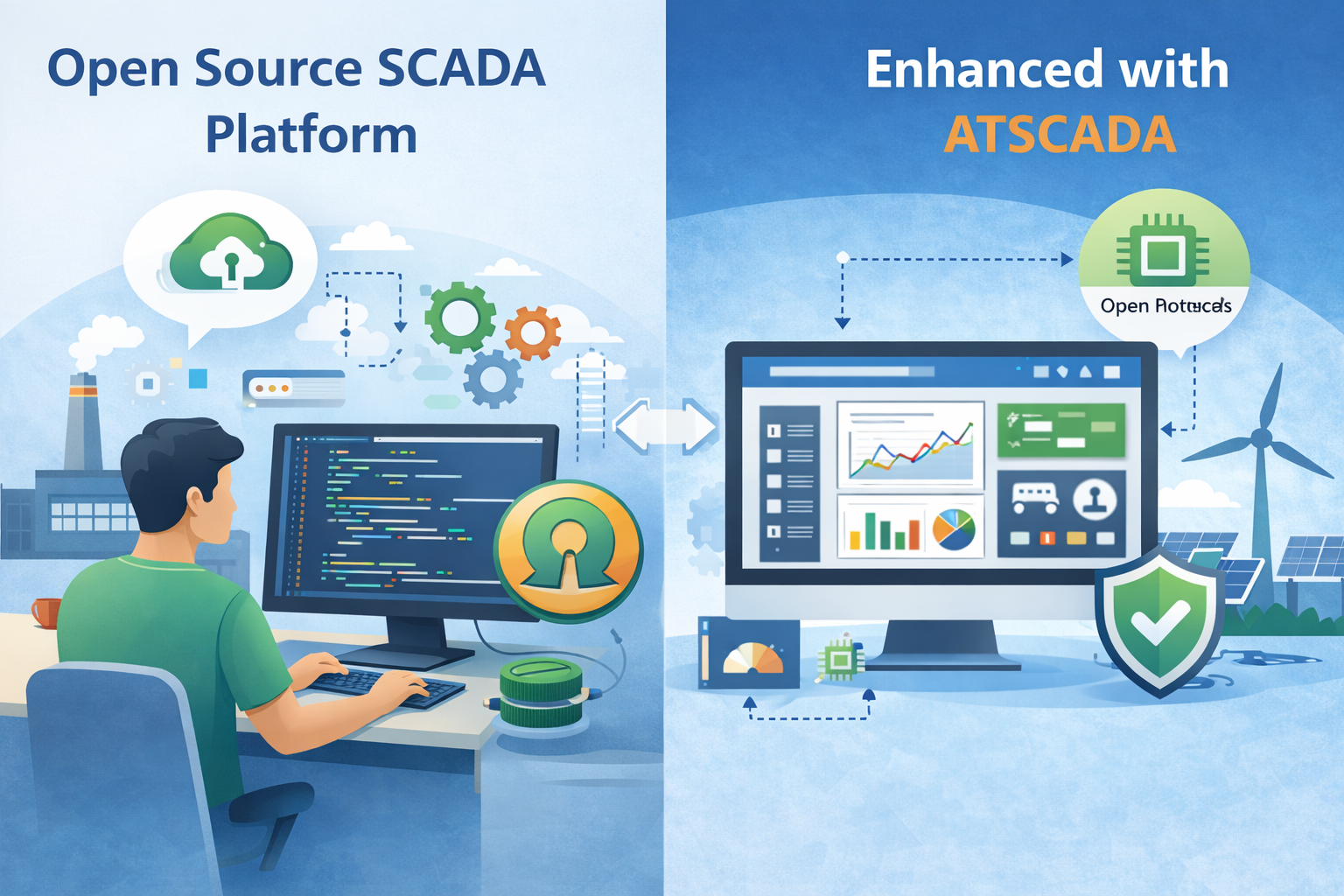
However, while open source solutions provide strong foundations, they often require advanced customization and integration capabilities. This is where ATSCADA plays a crucial role—bridging the gap between open source flexibility and enterprise-grade performance.
What Is an Open Source SCADA Platform?
An open source SCADA platform is a supervisory control and data acquisition system whose source code is publicly available. This allows developers and organizations to modify, customize, and extend the system according to their specific needs.
Key Characteristics
- Transparency: Full access to source code
- Customization: Tailor features to match operational requirements
- Community-driven development: Continuous improvements from global contributors
- Cost efficiency: Reduced licensing fees
These advantages make open source SCADA platforms attractive for businesses seeking flexibility and innovation.
Benefits of Using an Open Source SCADA Platform
1. Cost Savings
Open source solutions eliminate expensive licensing fees, making them ideal for startups and enterprises looking to optimize budgets.
2. High Customization
Organizations can adapt the system to modern web SCADA open source environments, including:
- Specific industrial processes
- Unique data workflows
- Custom dashboards and interfaces
3. Vendor Independence
Unlike proprietary systems, users are not locked into a single provider, allowing greater control over upgrades and system evolution.
4. Rapid Innovation
With contributions from global developers, open source SCADA platforms evolve quickly, incorporating new technologies such as IoT and AI.
Limitations of Open Source SCADA Platforms
While powerful, open source SCADA platforms also come with challenges:
Technical Complexity
Deployment and maintenance often require skilled engineers and developers.
Limited Official Support
Support is typically community-based, which may not meet enterprise-level requirements.
Security Concerns
Open code can expose vulnerabilities if not properly managed and secured.
Integration Challenges
Connecting multiple systems and protocols can become complex without a structured architecture.
How ATSCADA Enhances Open Source SCADA Platforms
ATSCADA complements the strengths of open source SCADA platforms while addressing their limitations, enabling open automation SCADA systems in modern industrial environments.
Enterprise-Ready Architecture
ATSCADA provides a stable, scalable environment that ensures reliable performance in industrial settings.
Seamless Integration
With support for standard protocols like OPC UA, MQTT, and Modbus, ATSCADA enables easy integration with open source components.
Advanced Visualization
ATSCADA delivers intuitive dashboards and real-time monitoring, transforming raw data into actionable insights.
Security and Reliability
Unlike many open source systems, ATSCADA includes built-in security features and robust system management.
Real-World Applications
An open source SCADA platform combined with ATSCADA can be applied across multiple industries:
Manufacturing
- Production monitoring
- Equipment performance tracking
- Predictive maintenance
Energy & Utilities
- Renewable energy management
- Grid monitoring
- Remote asset control
Water & Wastewater
- Pipeline monitoring
- Automated treatment systems
- Remote tank management
Smart Cities
- Infrastructure monitoring
- IoT-enabled systems
- Smart building automation
Best Practices for Implementation
To maximize the benefits of an open source SCADA platform, consider these strategies:
1. Define Clear Objectives
Understand your operational needs before selecting a platform.
2. Combine with a Reliable Platform
Use ATSCADA to enhance scalability, visualization, and integration.
3. Focus on Security
Implement:
- Data encryption
- Access control
- Network monitoring
4. Train Your Team
Ensure your engineers are equipped to manage and customize the system.
5. Plan for Scalability
Design your architecture to support future growth and expansion.
Future Trends in Open Source SCADA
The evolution of the open source SCADA platform is closely tied to emerging technologies:
- Edge computing for faster data processing
- AI and machine learning for predictive analytics
- Cloud integration for remote monitoring
- Digital twins for simulation and optimization
ATSCADA is continuously evolving to support these innovations, ensuring businesses stay ahead in a competitive industrial landscape.
Conclusion
An open source SCADA platform offers unmatched flexibility, cost efficiency, and innovation potential. However, to fully leverage these benefits, organizations need a robust and scalable system to manage complexity and ensure reliability.
By integrating open source capabilities with ATSCADA, businesses can achieve a powerful, future-ready SCADA solution that supports growth, efficiency, and digital transformation.
ATSCADA - Smart SCADA Software with AI Predictor & Blockchain. ATSCADA is an advanced SCADA software platform for real-time monitoring, intelligent control, and efficient data acquisition. It is ideal for Industrial IoT (IIoT), smart cities, integrated automation systems, and Agriculture 4.0. With a built-in AI Predictor, ATSCADA enables predictive analytics to detect issues early, optimize performance, and reduce downtime. The integration of Blockchain technology ensures secure, transparent, and tamper-proof data management. Highly scalable and easy to integrate, ATSCADA is trusted by businesses to enhance productivity, strengthen cybersecurity, and accelerate digital transformation.
Related articles
Utility SCADA Systems for Power, Water, and Infrastructure Management
In today’s rapidly evolving industrial landscape, Utility SCADA Systems play a critical role in managing [...]
Apr
Cost of a SCADA System: Complete Pricing Guide
Understanding the Cost of a SCADA System is essential for businesses planning to implement or [...]
Apr
SCADA Software Price: Complete Cost Guide for Industrial Systems
Understanding SCADA software price is essential for any organization planning to implement or upgrade industrial [...]
Apr
Cheap SCADA Software for Small and Medium Businesses
In today’s competitive industrial landscape, small and medium businesses (SMBs) are under constant pressure to [...]
Apr
Low Cost SCADA Solutions for Efficient Industrial Automation
In today’s competitive industrial landscape, companies are under constant pressure to improve efficiency while minimizing [...]
Apr
Ignition SCADA and AI: Integrating Intelligent Automation into Modern SCADA Systems
In modern industrial environments, Ignition SCADA and AI are increasingly combined to move beyond traditional [...]
Apr