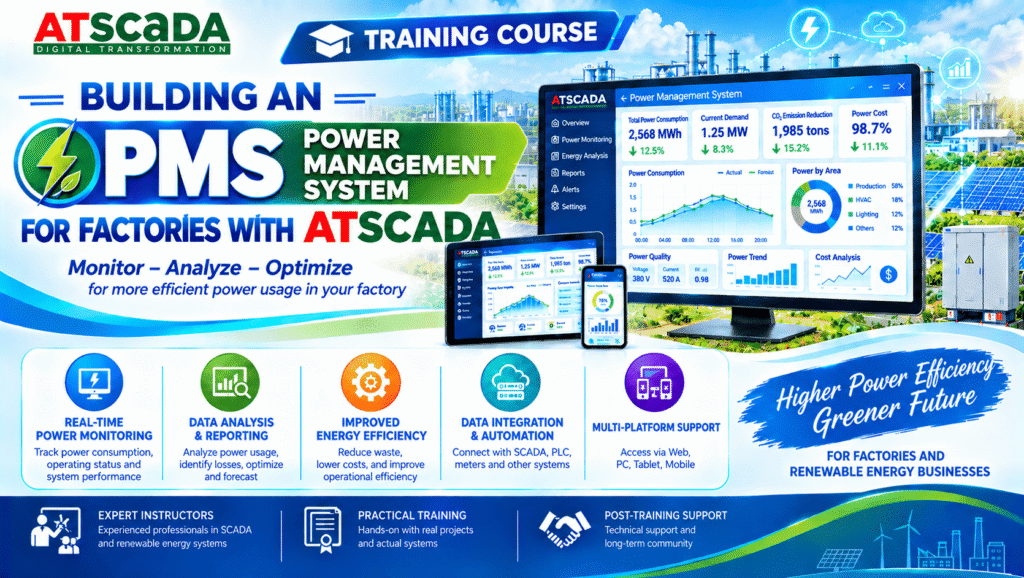
Training Course on Building a PMS System for Factory Power Management with ATSCADA

This training course helps students, technicians, and engineers in the field of electrical engineering and automation to enhance their knowledge and gain experience. Duration: 1 Session – Learning Format: Online via Google Meet

We are giving away high-quality and multi-disciplinary ATSCADA training materials to our students.

sign up now


Why should you take the SCADA course at ATSCADA?

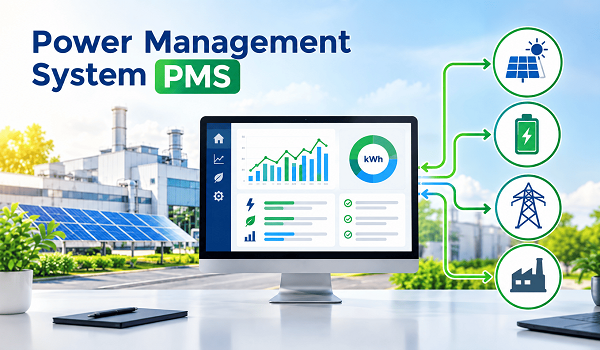
Power-management-system-Pms

ABOUT US

ATSCADA helps businesses grow further through comprehensive automation solutions.

ATSCADA Lab, a subsidiary of ATPro Corp, was formed and developed from the ATSCADA platform established in 2009, marking the beginning of our journey to build “Made in Vietnam” SCADA solutions. With a shared aspiration and long-term vision, we continuously research, develop, and refine core technology platforms, aiming to build a SCADA  software “empire”  with a distinct Vietnamese identity, capable of competing in regional and international markets.

Who should participate in the ATSCADA training course?

Many engineers struggle with SCADA systems because they rely solely on: Online tutorials that don’t require actual equipment –  ​​Disjointed documentation –  Outdated training methods

What was the result?  Slow progress, poor practical skills, and limited career advancement opportunities. ATSCADA has completely changed this.

Course Content: BUILDING A PMS SYSTEM FOR FACTORY POWER MANAGEMENT WITH ATSCADA

From multi-stage metering and rooftop solar to cost analysis and power comparison on the Web.

How much electricity is the factory using, in which building, and on which machine? What percentage of the load is being handled by the rooftop solar panels, and is there any feedback into the grid? How much is the electricity bill today, more or less than yesterday? This webinar will guide you in building a complete energy management demo for a 14-building factory complex, with data seamlessly integrated from EMKO PLCs to ATDriverServer, using Windows Forms applications and a web interface.

Phase 1: PLC Programming & Data Connection

Create a data and metering platform for the entire plant.

  • Logical simulation:  Ladder programming simulates a multi-level electricity meter system, including a main meter, area meters, individual building meters, and individual appliance meters, along with a solar power system on 14 rooftops.
  • Modbus connection:  Configure EMKO PLC with ATDriverServer, declare and test Tags.
  • Comparing the data:  Understanding the power balance: grid electricity + solar electricity = actual electricity consumption, plus transformer losses.

Phase 2: Building a visual SCADA interface on the Web.

From the factory floor plan to every single piece of machinery inside each building.

  • Designed by Fastweb Designer & iSVGEditor:  Overall site plan, detailed building plans, and rooftop solar power system plan.
  • Real-time data mapping:  Attach tags to display power, energy consumption, power factor, and status of each meter.
  • Animation based on real-world states:  Fans spin, robots operate, machines vibrate, current flows through the busway, all according to the start/stop signals from the PLC.

Phase 3: Power Analysis & Calculation

Transform measurement data into manageable figures: money, trends, and comparisons.

  • Calculations with iEnergyTools:  Two methods for calculating electricity consumption and a self-checking feature; electricity bills based on three time frames; savings from solar power; Min/Avg/Max statistics.
  • Compare electricity consumption:  Today with yesterday, with the 7-day average, and with any recorded day. Allocate electricity costs by area.

Storage & Reporting:  Write data to the database, query it, and export Excel reports using ATSCADA components.

Phase 4: Demonstrating real-world operational problems

Observe how the system responds to common factory scenarios.

  • Zero Export:  A controller that prevents reverse power transmission to the grid, selects safe thresholds, and provides a safe mode in case of clock signal loss.
  • Power supply fluctuations:  Cloud cover, grid outages and inverter disconnection, inverter malfunctions.
  • Cost problem:  The power factor drops when solar power is present, and the overlapping load increases peak power for 15 minutes.

After the webinar, participants will understand how to build a complete factory power management system, from metering to cost analysis, and will have the foundation to implement energy monitoring solutions for their businesses. The content is suitable for PLC/SCADA engineers, factory electrical engineers, system integrators, implementation partners, and businesses exploring power management solutions and rooftop solar power.

Training Course on Building a PMS System for Factory Power Management with ATSCADA