
SCADA Protocols
EtherCAT Protocol Explained: How EtherCAT Works in Industrial Automation
What is the ethercat protocol? How does the EtherCAT (Ethernet for Control Automation Technology) industrial communication protocol work? Let’s explore the details with atscada.com in this article!
What is the ethercat protocol?
The ethercat protocol (Ethernet for Control Automation Technology) is an open real-time Ethernet Master/Slave network. This industrial communication protocol enables high-performance real-time operation, capable of processing up to 1000 distributed I/O in 30µs or 100 axes in 100µs using twisted-pair or fiber optic cables.
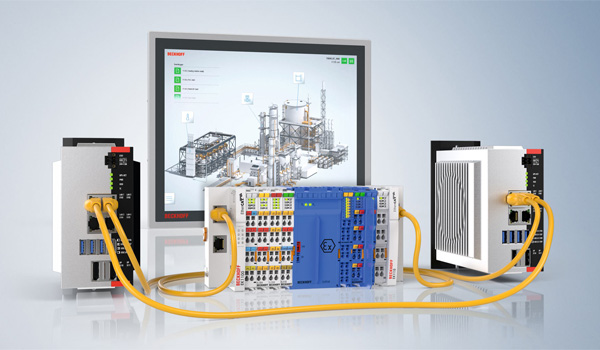
The ethercat protocol uses Ethernet to transmit data and synchronize devices within a system. A key advantage of Ethernet is its ability to transmit data across multiple devices in a single chain, helping reduce cabling costs and installation time.
Today, the ethercat protocol is widely used in applications such as motion control, machine control, and many other industrial automation systems.
History of the ethercat protocol
Beckhoff Automation originally developed the ethercat protocol for real-time control and industrial automation systems, specializing in PLC (Programmable Logic Controller) solutions.
Beckhoff Automation introduced to the world in 2003. In 2004, they transferred it to EtherCAT Technology Group (ETG), the organization responsible for promoting and developing this standard. Today, the ethercat protocol is standardized under IEC 61158.
Operating principles of the ethercat protocol
The ethercat protocol uses a “processing on the fly” principle, sending messages to multiple nodes instead of a single node and transmitting them sequentially through the network before full processing.
For input data, each node reads and processes the relevant information as the message passes through. For output data, each node inserts its data into the message before forwarding it to the next node in the network.
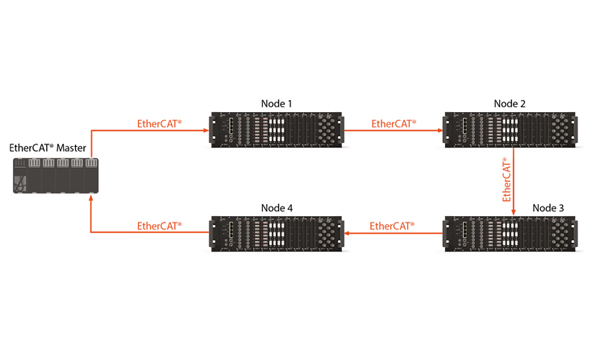
The ethercat protocol uses a single data frame sent master to all nodes. This message circulates through the network and returns to the master, ensuring that every node receives updated input data from the master and sends back new output data.
When there are no small payload limitations and messages are targeted to specific nodes, the ethercat protocol can achieve maximum bandwidth utilization.
Advantages of the ethercat protocol
- Offers high performance, featuring an industrial Ethernet architecture with speeds up to 200 Mbps (full duplex: 100 Mbps × 2).
- It provides high precision with real-time operation and synchronization accuracy of approximately 1 ns.
- Supports flexible network topologies, including line, ring, star, and tree structures without limitations.
- It does not require a central hub or switch, enabling nearly unlimited network scalability.
- The system is easy to operate, as the master automatically assigns node addresses and distributes clock synchronization messages.
- Configuration is simple, with no need to manage IP or MAC addresses.
Key differences between Ethernetocol
| Comparison criteria | Ethernet | EtherCAT |
| Physical and data link layers | Yes | Yes |
| International standard | IEEE-802.3 | IEC 61158 |
| Deterministic timing | No | Yes |
| Master/Slave operation | No | Yes |
| Ring topology support | Not required | Yes |
| Real-time control capability | No | Yes |
| Collision avoidance optimization | No | Yes |
Key applications of the ethercat protocol
Today, various systems and applications widely use and deploy the ethercat protocol, including:
- Industrial automation systems
- PLC (Programmable Logic Controller) network protocols
- Data acquisition systems
- Automated manufacturing systems
- Printing systems
- Agricultural production lines
- Pulp and paper mills, metallurgy plants
In large-scale or remote industrial environments, solutions such as RS485 to LoRa Converter are often integrated to extend communication distance and enable wireless data transmission between distributed systems.
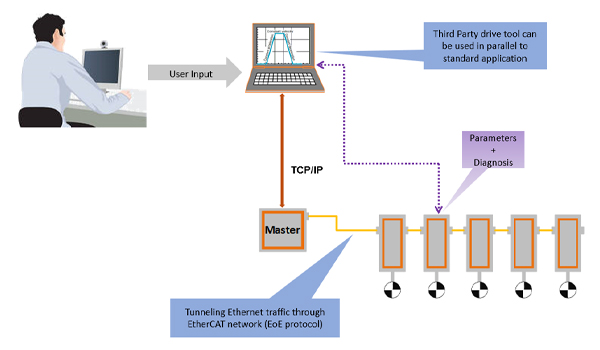
The above are the basic insights about that atscada.com has compiled and would like to share with you. Many industrial systems and applications currently deploy this protocol.
If you have any questions or need further assistance, please feel free to contact our sales hotline for detailed support. Thank you!
ATSCADA - Smart SCADA Software with AI Predictor & Blockchain. ATSCADA is an advanced SCADA software platform for real-time monitoring, intelligent control, and efficient data acquisition. It is ideal for Industrial IoT (IIoT), smart cities, integrated automation systems, and Agriculture 4.0. With a built-in AI Predictor, ATSCADA enables predictive analytics to detect issues early, optimize performance, and reduce downtime. The integration of Blockchain technology ensures secure, transparent, and tamper-proof data management. Highly scalable and easy to integrate, ATSCADA is trusted by businesses to enhance productivity, strengthen cybersecurity, and accelerate digital transformation.
Related articles
MQTT Protocol Explained: What Is MQTT and How It Works
Choosing the right connectivity protocol is a crucial step in building an IoT system, and [...]
Mar
MQTT Gateway Selection Guide: How to Choose the Right MQTT Gateway
The mqtt gateway market in Industry 4.0 is highly diverse, offering various types to meet [...]
Nov
RS485 to LORA CONVERTER IN SCADA NETWORK
What is RS485 to LoRa Converter? Are you worried about complex wiring in Modbus RTU [...]
May
Modbus Power Meter Integration with ATDriver Server
In industrial energy monitoring systems, accurate data acquisition from power meters is essential for optimizing [...]
Oct
KepServer OPC Connection with Delta PLC via Modbus ASCII
In industrial automation systems, seamless communication between PLC devices and SCADA software is essential for [...]
Oct
Modbus TCP/IP Connection with S7-1200 PLC Using ATDriver Server
In modern industrial automation systems, seamless and reliable communication between SCADA platforms and PLCs is [...]
Oct