
Technical Guides
SCADA Software Developer in Modern Industry: From Code to Control
Behind every efficient factory, energy system, or smart infrastructure lies the work of a scada software developer. Unlike traditional software roles, this position blends coding skills with real-world industrial understanding.
Instead of building typical applications, a SCADA developer creates systems that directly interact with machines, sensors, and production lines. With platforms like ATSCADA, the development process becomes faster, more flexible, and aligned with Industry 4.0 requirements.
The Role of a SCADA Software Developer in Real Projects
A scada software developer does not just write code—they design how an entire industrial system behaves.
Their work often includes:
- Mapping real-world processes into digital systems
- Designing control logic for automation workflows
- Building visual dashboards for operators
- Ensuring stable communication between devices
What makes this role unique is the need to understand both software architecture and physical systems.
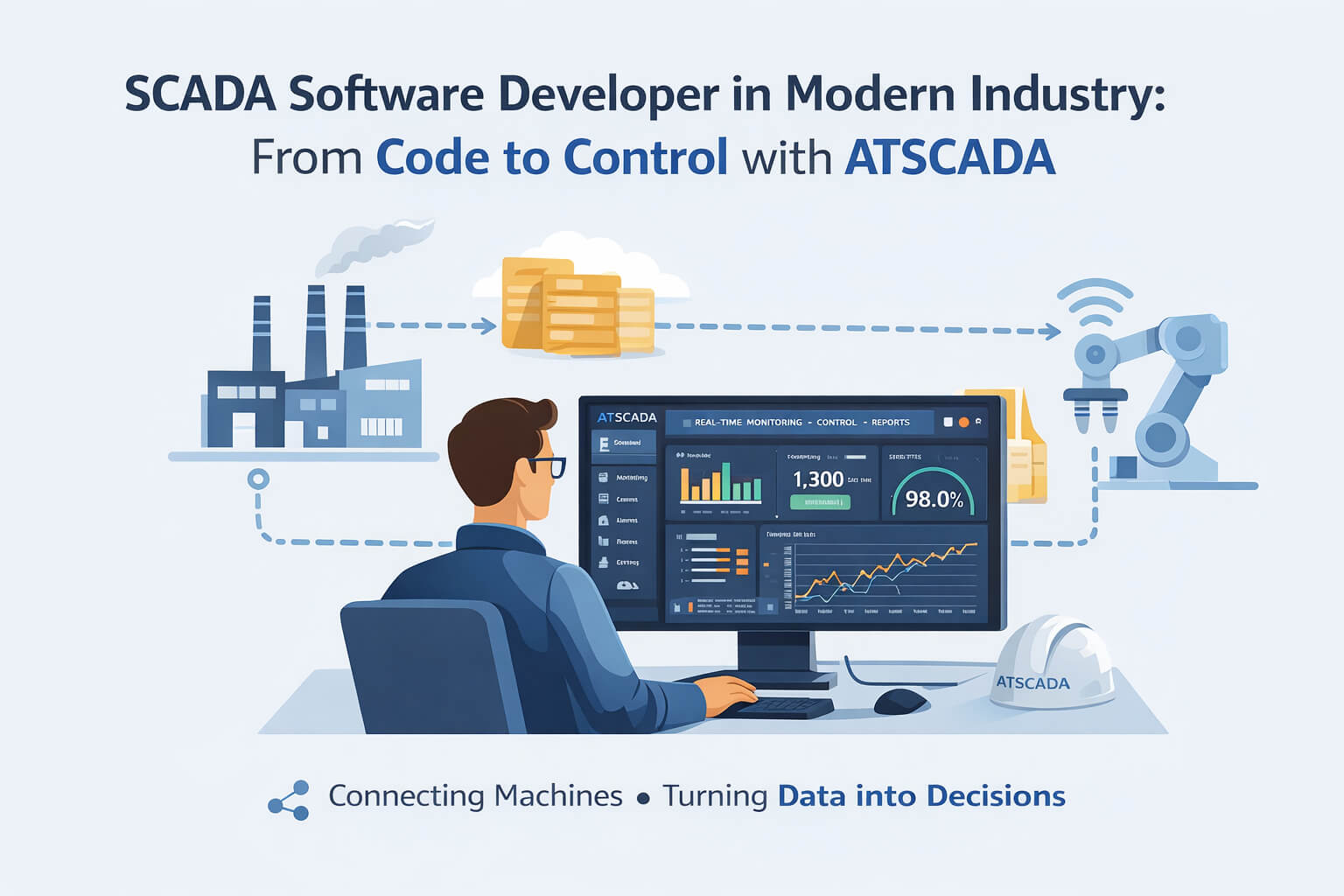
From Data to Decisions: How Developers Shape SCADA Systems
Turning Raw Signals into Insights
Industrial systems generate massive amounts of raw data. A scada software developer transforms that data into meaningful insights using advanced SCADA computer software solutions .
This involves:
- Structuring data flows from sensors
- Filtering and processing real-time signals
- Presenting information visually
With ATSCADA, developers can create dashboards that simplify even the most complex operations.
Designing for Humans, Not Just Machines
A SCADA system is only effective if operators can use it easily.
That’s why developers must think about:
- Clear layout design
- Minimal cognitive load
- Fast response interaction
Instead of overwhelming users, ATSCADA allows developers to build clean and intuitive interfaces.
The Technical Backbone of SCADA Development
Communication Protocols and Integration
One of the biggest challenges is ensuring everything “talks” to each other.
A scada software developer must handle:
- PLC communication (Modbus, OPC, MQTT)
- Device synchronization
- Data consistency across systems
ATSCADA simplifies this layer by supporting multiple protocols out of the box.
System Scalability and Architecture
Industrial systems are never static. They grow.
Developers must design SCADA systems that can:
- Expand without downtime
- Add new devices easily
- Handle increasing data loads
ATSCADA is built with scalability in mind, making it easier to adapt systems over time.
Where SCADA Software Developers Make the Biggest Impact
Smart Manufacturing
In production environments, a scada software developer directly influences efficiency.
Their systems help:
- Detect bottlenecks
- Monitor machine performance
- Improve product consistency
Energy and Sustainability
Energy systems require precise monitoring and optimization
SCADA developers build systems that track consumption and reduce waste.
Infrastructure and Utilities
From water treatment plants to transportation networks, SCADA developers enable centralized control of distributed systems.
Why ATSCADA Is a Powerful Tool for SCADA Software Developers
Faster Development Cycles
ATSCADA reduces development time by providing ready-to-use modules and flexible configuration.
High Customization
Developers can tailor systems based on:
- Industry requirements
- Process complexity
- User roles
Real-Time Performance
ATSCADA ensures low-latency data processing, which is critical for industrial environments.
Future-Ready Integration
With support for IoT and cloud technologies, ATSCADA helps developers build systems that are ready for future expansion.
Challenges SCADA Software Developers Face
Even with powerful tools, the role comes with challenges:
- Handling legacy systems
- Ensuring cybersecurity
- Managing large-scale data
- Maintaining system reliability
ATSCADA addresses many of these challenges through a stable and secure platform.
Best Practices for Modern SCADA Development
To build effective systems, a scada software developer should follow structured SCADA software design principles :
- Prioritize clarity in interface design
- Use modular system architecture
- Implement strong security measures
- Continuously monitor system performance
- Plan for scalability from the beginning
The Future of SCADA Software Development
The role of the scada software developer is evolving rapidly.
Key trends include:
- AI-powered predictive systems
- Cloud-based SCADA platforms
- Edge computing for faster response
- Integration with digital twins
ATSCADA continues to evolve alongside these trends, ensuring developers stay ahead.
Conclusion: More Than Just Code
A scada software developer is not just a programmer—they are system architects of the industrial world. Their work ensures that machines, data, and people operate in harmony.
With ATSCADA, developers gain the tools needed to build reliable, scalable, and intelligent SCADA systems that meet the demands of modern industry.

ATSCADA - Smart SCADA Software with AI Predictor & Blockchain. ATSCADA is an advanced SCADA software platform for real-time monitoring, intelligent control, and efficient data acquisition. It is ideal for Industrial IoT (IIoT), smart cities, integrated automation systems, and Agriculture 4.0. With a built-in AI Predictor, ATSCADA enables predictive analytics to detect issues early, optimize performance, and reduce downtime. The integration of Blockchain technology ensures secure, transparent, and tamper-proof data management. Highly scalable and easy to integrate, ATSCADA is trusted by businesses to enhance productivity, strengthen cybersecurity, and accelerate digital transformation.
Related articles
Utility SCADA Systems for Power, Water, and Infrastructure Management
In today’s rapidly evolving industrial landscape, Utility SCADA Systems play a critical role in managing [...]
Apr
Cost of a SCADA System: Complete Pricing Guide
Understanding the Cost of a SCADA System is essential for businesses planning to implement or [...]
Apr
SCADA Software Price: Complete Cost Guide for Industrial Systems
Understanding SCADA software price is essential for any organization planning to implement or upgrade industrial [...]
Apr
Cheap SCADA Software for Small and Medium Businesses
In today’s competitive industrial landscape, small and medium businesses (SMBs) are under constant pressure to [...]
Apr
Low Cost SCADA Solutions for Efficient Industrial Automation
In today’s competitive industrial landscape, companies are under constant pressure to improve efficiency while minimizing [...]
Apr
Ignition SCADA and AI: Integrating Intelligent Automation into Modern SCADA Systems
In modern industrial environments, Ignition SCADA and AI are increasingly combined to move beyond traditional [...]
Apr