
Technical Guides
SCADA Software Engineer: Roles, Skills, and Real-World Applications
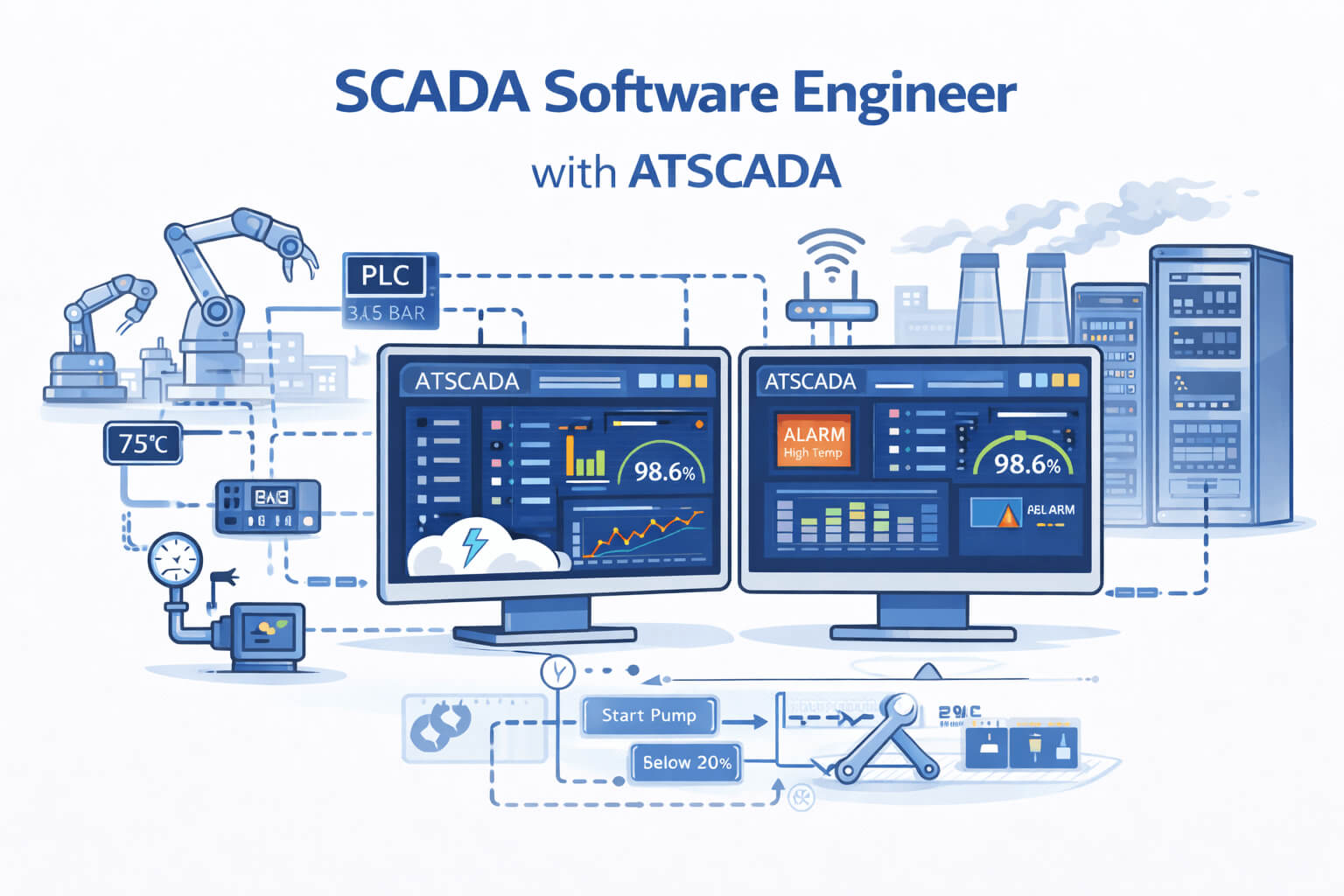
Behind every automated factory, energy system, or smart infrastructure is a scada software engineer responsible for designing and maintaining control systems. This role goes beyond traditional software development—it requires a deep understanding of industrial processes, communication protocols, and real-time data systems.
With modern platforms like ATSCADA, SCADA engineers can build scalable, efficient, and intelligent systems that meet Industry 4.0 demands.
This guide explores what a SCADA software engineer does, the skills required, and how ATSCADA supports real-world applications.
What Does a SCADA Software Engineer Do?
A scada software engineer develops systems that monitor and control industrial operations. Their work directly connects software with physical equipment.
Typical responsibilities include:
- Designing SCADA system architecture
- Developing control logic for automation
- Integrating PLCs and field devices
- Building user interfaces (HMI dashboards)
- Ensuring reliable communication between systems
Unlike conventional developers, SCADA engineers must understand both software and hardware environments.
Core Skills of a SCADA Software Engineer
To succeed, a scada software engineer needs a combination of technical and industrial knowledge.
Programming and Logic Design
Engineers must write and structure logic for automation systems, often based on practical SCADA program examples
Common tools:
- PLC programming (Ladder Logic, Structured Text)
- Scripting for SCADA platforms
- Database handling
Industrial Communication Protocols
Communication is critical in SCADA systems.
Key protocols include:
- Modbus
- OPC UA
- MQTT
ATSCADA supports these protocols, making integration easier.
System Architecture Design
A SCADA engineer must design systems that are:
- Scalable
- Reliable
- Easy to maintain
This includes planning how devices, servers, and networks interact.
Data Visualization and UI Design
A SCADA system is only effective if operators can understand it.
Engineers design:
- Dashboards
- Charts and graphs
- Alarm panels
ATSCADA provides tools to build intuitive interfaces quickly.
How ATSCADA Supports SCADA Software Engineers
Modern development requires tools that reduce complexity and increase efficiency.
Faster Development Process
ATSCADA allows engineers to:
- Configure systems visually
- Use pre-built modules
- Reduce manual coding
This accelerates project delivery.
Real-Time Data Processing
A scada software engineer must handle real-time data.
ATSCADA ensures:
- Low latency communication
- Instant data updates
- Reliable system performance
Flexible Integration
Industrial environments often include diverse devices.
ATSCADA enables:
- Multi-protocol communication
- Easy device connection
- Seamless system expansion
Scalable System Design
As systems grow, scalability becomes essential.
ATSCADA supports:
- Multi-site deployment
- Cloud integration
- Large-scale data handling
Real-World Applications of SCADA Software Engineers
Smart Manufacturing
In factories, a scada software engineer helps:
- Monitor production lines
- Detect inefficiencies
- Improve product quality
Energy and Utilities
SCADA engineers manage energy systems and optimization processes using comprehensive SCADA energy software guides, including:
- Power distribution systems
- Renewable energy monitoring
- Energy optimization
Infrastructure and Smart Cities
Applications include:
- Water treatment systems
- Transportation networks
- Building automation
A Day in the Life of a SCADA Software Engineer
A typical workflow might include:
- Reviewing system performance data
- Updating control logic
- Troubleshooting communication issues
- Improving dashboard design
- Testing system reliability
Using ATSCADA, many of these tasks become faster and more intuitive.
Best Practices for SCADA Software Engineers
To build effective systems, follow these principles:
Keep Systems Modular
Break systems into smaller components for easier maintenance.
Prioritize Reliability
Industrial systems must run continuously without failure.
Focus on User Experience
Design dashboards that are simple and clear.
Ensure Cybersecurity
Protect systems from unauthorized access.
Plan for Scalability
Always design systems that can grow over time.
Common Challenges in SCADA Engineering
Even experienced engineers face difficulties:
- Integrating legacy systems
- Managing large data volumes
- Ensuring real-time performance
- Maintaining system security
ATSCADA helps address these challenges through a stable and flexible platform.
The Future of SCADA Software Engineering
The role of the scada software engineer is evolving rapidly.
Key trends include:
- AI-driven predictive maintenance
- Cloud-based SCADA platforms
- Edge computing
- Digital twin integration
ATSCADA continues to innovate, helping engineers stay ahead of these trends.
Conclusion
A scada software engineer plays a critical role in modern industry, bridging the gap between software and physical systems. Their work ensures efficient, reliable, and intelligent operations across various sectors.
With ATSCADA, engineers gain powerful tools to design, deploy, and scale SCADA systems more effectively.
As industrial automation continues to advance, the demand for skilled SCADA software engineers will only grow.

ATSCADA - Smart SCADA Software with AI Predictor & Blockchain. ATSCADA is an advanced SCADA software platform for real-time monitoring, intelligent control, and efficient data acquisition. It is ideal for Industrial IoT (IIoT), smart cities, integrated automation systems, and Agriculture 4.0. With a built-in AI Predictor, ATSCADA enables predictive analytics to detect issues early, optimize performance, and reduce downtime. The integration of Blockchain technology ensures secure, transparent, and tamper-proof data management. Highly scalable and easy to integrate, ATSCADA is trusted by businesses to enhance productivity, strengthen cybersecurity, and accelerate digital transformation.
Related articles
Utility SCADA Systems for Power, Water, and Infrastructure Management
In today’s rapidly evolving industrial landscape, Utility SCADA Systems play a critical role in managing [...]
Apr
Cost of a SCADA System: Complete Pricing Guide
Understanding the Cost of a SCADA System is essential for businesses planning to implement or [...]
Apr
SCADA Software Price: Complete Cost Guide for Industrial Systems
Understanding SCADA software price is essential for any organization planning to implement or upgrade industrial [...]
Apr
Cheap SCADA Software for Small and Medium Businesses
In today’s competitive industrial landscape, small and medium businesses (SMBs) are under constant pressure to [...]
Apr
Low Cost SCADA Solutions for Efficient Industrial Automation
In today’s competitive industrial landscape, companies are under constant pressure to improve efficiency while minimizing [...]
Apr
Ignition SCADA and AI: Integrating Intelligent Automation into Modern SCADA Systems
In modern industrial environments, Ignition SCADA and AI are increasingly combined to move beyond traditional [...]
Apr