
Technical Guides
SCADA EMS Software: Advanced Energy Management Systems
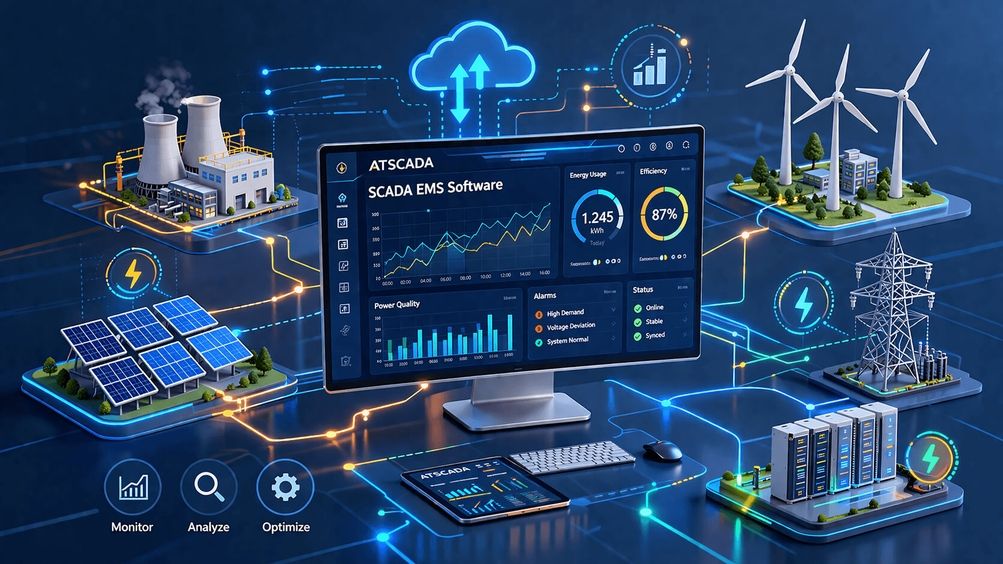
As industries strive to improve efficiency and reduce operational costs, energy management has become a top priority. A scada ems software solution combines the power of SCADA systems with Energy Management Systems (EMS) to deliver real-time monitoring, control, and optimization of energy usage.
Modern platforms like ATSCADA are designed to help organizations manage complex energy infrastructures with precision and flexibility.
In this guide, we explore how works, its key components, and how ATSCADA supports advanced energy management in industrial environments.
What Is SCADA EMS Software?
SCADA EMS software is an integrated solution that merges SCADA (Supervisory Control and Data Acquisition) with EMS (Energy Management System) functionalities.
It allows organizations to:
- Monitor energy consumption in real time
- Analyze energy usage patterns
- Optimize energy distribution
- Automate energy-related processes
Unlike basic monitoring systems, SCADA EMS software provides actionable insights for decision-making.
Why SCADA EMS Software Is Essential
Energy inefficiency leads to increased costs and reduced sustainability. A scada ems software system helps organizations address these challenges effectively.
Key Benefits
- Real-time visibility: Track energy usage instantly
- Cost reduction: Identify and eliminate waste
- Improved reliability: Detect anomalies early
- Regulatory compliance: Meet energy standards
With ATSCADA, these benefits are easier to achieve through a unified platform.
Core Components of SCADA EMS Software
Understanding the architecture of a system is crucial.
Field Devices and Energy Meters
These devices collect raw data such as:
- Voltage
- Current
- Power consumption
- Frequency
They serve as the data source for the system.
Control Systems (PLC/RTU)
Controllers process incoming data and execute automation logic, often based on structured SCADA program examples
Functions include:
- Load control
- Demand management
- Fault detection
Communication Layer
This layer ensures seamless data transfer.
Common protocols:
- Modbus
- OPC UA
- MQTT
ATSCADA supports multiple protocols, simplifying integration.
SCADA EMS Platform
This is the central system where data is processed and analyzed.
ATSCADA provides:
- Real-time monitoring
- Alarm management
- Historical data storage
Visualization and Reporting
Operators interact with the system through dashboards.
Features include:
- Energy consumption charts
- Trend analysis
- Custom reports
How ATSCADA Enhances SCADA EMS Software
Traditional systems can be complex and difficult to scale, requiring skilled SCADA software engineers to manage development and integration, while ATSCADA simplifies development and operation.
Real-Time Monitoring and Control
ATSCADA enables:
- Instant data updates
- Fast response to anomalies
- Improved operational efficiency
Advanced Analytics
System becomes powerful when combined with analytics.
ATSCADA supports:
- Predictive analysis
- Energy forecasting
- Performance benchmarking
Flexible and Scalable Architecture
Energy systems often expand over time.
ATSCADA allows:
- Easy system upgrades
- Multi-site management
- Cloud integration
User-Friendly Interface
Operators need clarity and simplicity.
ATSCADA dashboards are:
- Intuitive
- Customizable
- Easy to navigate
Real-World Applications of SCADA EMS Software
Industrial Manufacturing
Factories use scada ems software to:
- Monitor energy consumption per machine
- Optimize production efficiency
- Reduce downtime
Power Generation and Distribution
Utilities rely on SCADA EMS systems to:
- Balance energy supply and demand
- Monitor grid performance
- Detect faults quickly
Renewable Energy Systems
SCADA EMS software plays a key role in:
- Solar power monitoring
- Wind energy management
- Energy storage optimization
Smart Buildings
Buildings benefit from:
- HVAC optimization
- Lighting control
- Reduced energy costs
Best Practices for Implementing SCADA EMS Software
To maximize effectiveness, follow these guidelines:
Define Clear Objectives
Identify goals such as cost reduction or sustainability improvement.
Ensure Accurate Data Collection
Reliable sensors and proper calibration are essential.
Focus on Scalability
Choose a platform like ATSCADA that supports future expansion.
Implement Strong Security Measures
Protect critical energy infrastructure with secure communication and access control.
Continuously Analyze Data
Regular monitoring helps identify new optimization opportunities.
Common Challenges and Solutions
Integrating Legacy Systems
Older systems can be difficult to connect.
ATSCADA solves this with multi-protocol support.
Managing Large Data Volumes
Energy systems generate massive data.
ATSCADA simplifies this through:
- Data filtering
- Smart dashboards
- Automated alerts
Ensuring System Reliability
Downtime can be costly.
ATSCADA ensures stable and consistent performance.
The Future of SCADA EMS Software
Energy systems are evolving rapidly.
Key trends include:
- AI-driven energy optimization
- Cloud-based SCADA EMS platforms
- Edge computing
- Smart grid integration
ATSCADA continues to evolve alongside these trends, ensuring long-term value.
Conclusion
A scada ems software solution is essential for modern energy management. It provides real-time monitoring, advanced analytics, and intelligent control of energy systems.
With ATSCADA, organizations can build scalable, efficient, and future-ready energy management solutions.
As industries move toward sustainability and digital transformation, adopting SCADA EMS software is a strategic investment.
ATSCADA - Smart SCADA Software with AI Predictor & Blockchain. ATSCADA is an advanced SCADA software platform for real-time monitoring, intelligent control, and efficient data acquisition. It is ideal for Industrial IoT (IIoT), smart cities, integrated automation systems, and Agriculture 4.0. With a built-in AI Predictor, ATSCADA enables predictive analytics to detect issues early, optimize performance, and reduce downtime. The integration of Blockchain technology ensures secure, transparent, and tamper-proof data management. Highly scalable and easy to integrate, ATSCADA is trusted by businesses to enhance productivity, strengthen cybersecurity, and accelerate digital transformation.
Related articles
Utility SCADA Systems for Power, Water, and Infrastructure Management
In today’s rapidly evolving industrial landscape, Utility SCADA Systems play a critical role in managing [...]
Apr
Cost of a SCADA System: Complete Pricing Guide
Understanding the Cost of a SCADA System is essential for businesses planning to implement or [...]
Apr
SCADA Software Price: Complete Cost Guide for Industrial Systems
Understanding SCADA software price is essential for any organization planning to implement or upgrade industrial [...]
Apr
Cheap SCADA Software for Small and Medium Businesses
In today’s competitive industrial landscape, small and medium businesses (SMBs) are under constant pressure to [...]
Apr
Low Cost SCADA Solutions for Efficient Industrial Automation
In today’s competitive industrial landscape, companies are under constant pressure to improve efficiency while minimizing [...]
Apr
Ignition SCADA and AI: Integrating Intelligent Automation into Modern SCADA Systems
In modern industrial environments, Ignition SCADA and AI are increasingly combined to move beyond traditional [...]
Apr