
Technical Guides
Environmental Monitoring Examples: Practical Applications Across Industries
Environmental monitoring has become a critical component of modern industry, enabling organizations to track, analyze, and respond to environmental conditions in real time. From air quality control to water treatment and industrial emissions, understanding environmental monitoring examples helps businesses adopt more efficient, compliant, and sustainable operations.
With the integration of advanced SCADA platforms like ATSCADA, environmental monitoring is no longer a manual or reactive process—it is now automated, data-driven, and highly scalable.
What Is Environmental Monitoring?
Environmental monitoring refers to the systematic collection of data related to environmental conditions such as air, water, soil, and noise. This data is used to ensure compliance with regulations, improve safety, and support sustainability initiatives.
Modern monitoring systems often rely on sensors, IoT devices, and environmental monitoring software to deliver real-time insights and control.
Why Environmental Monitoring Matters in Industry
Environmental monitoring is essential for:
- Ensuring regulatory compliance
- Reducing environmental risks
- Improving operational efficiency
- Supporting sustainability goals
- Enhancing workplace safety
By leveraging platforms like ATSCADA, organizations can centralize monitoring data, automate alerts, and generate actionable reports.
Key Environmental Monitoring Examples Across Industries
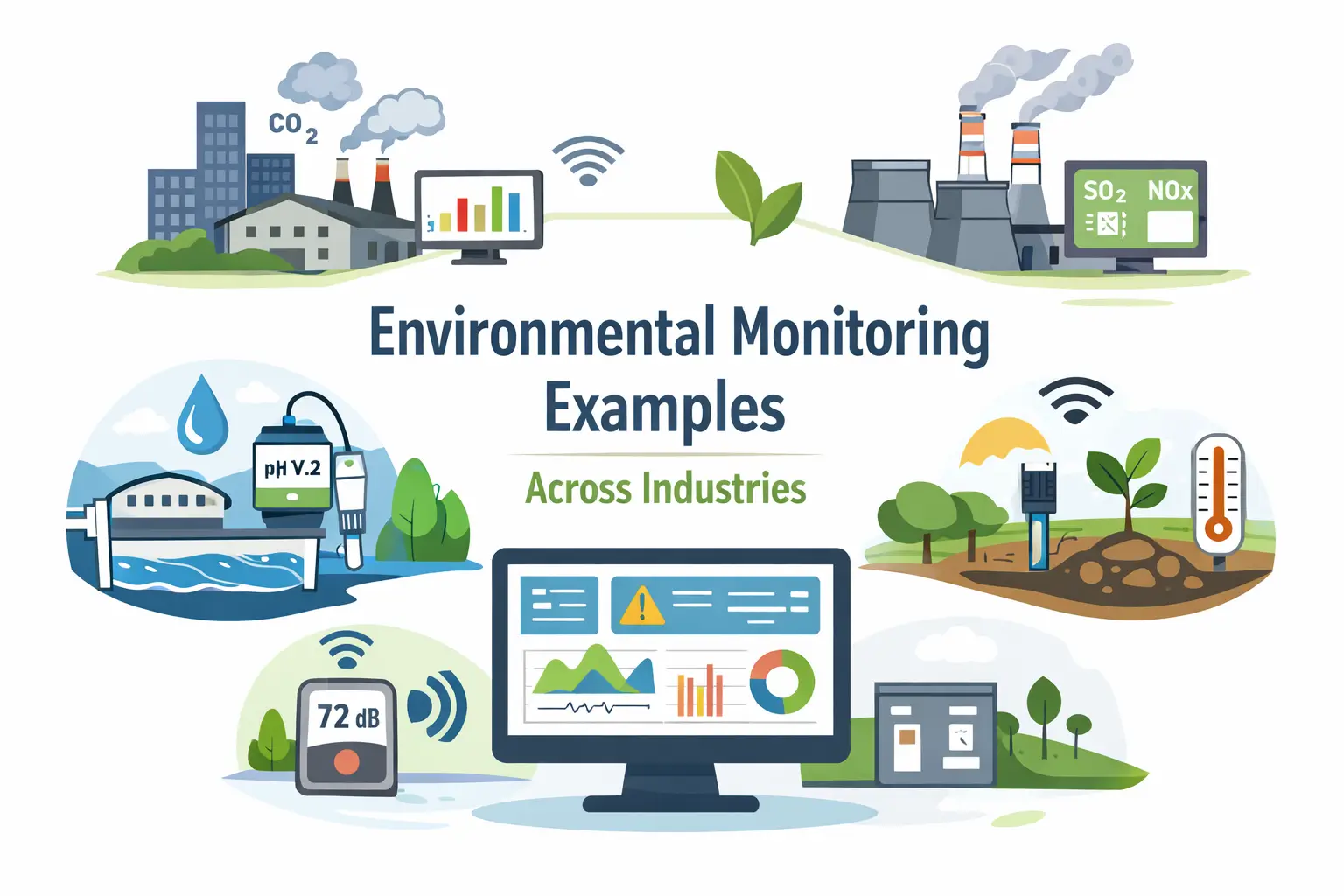
Below are some of the most common and impactful environmental monitoring examples used in real-world applications.
Air Quality Monitoring Systems
Air pollution monitoring is widely used in industries such as manufacturing, mining, and urban infrastructure.
Typical Applications:
- Monitoring particulate matter (PM2.5, PM10)
- Tracking CO₂ and harmful gas emissions
- Controlling ventilation systems
Benefits:
- Improved worker safety
- Compliance with environmental standards
- Real-time alerting for hazardous conditions
SCADA systems like ATSCADA allow operators to visualize air quality data through dashboards and respond instantly to threshold breaches.
Water Quality Monitoring in Treatment Plants
Water treatment facilities rely heavily on continuous monitoring to ensure safe and clean water supply.
Parameters Monitored:
- pH levels
- Turbidity
- Dissolved oxygen
- Chemical concentrations
Practical Use Case:
SCADA integration enables automated control of pumps, valves, and chemical dosing systems based on real-time data.
Industrial Emissions Monitoring
Factories and power plants must monitor emissions to comply with environmental regulations.
Key Metrics:
- Sulfur dioxide (SO₂)
- Nitrogen oxides (NOx)
- Carbon monoxide (CO)
SCADA Role:
ATSCADA can aggregate emissions data from multiple sources, providing centralized monitoring and automated reporting.
Soil and Agricultural Monitoring
In agriculture, environmental monitoring plays a key role in optimizing crop yield and resource usage.
Monitored Factors:
- Soil moisture
- Temperature
- Nutrient levels
Benefits:
- Precision irrigation
- Reduced water waste
- Improved crop productivity
With SCADA systems, farmers can remotely monitor field conditions and automate irrigation systems.
Noise Monitoring in Urban and Industrial Areas
Noise pollution is a growing concern, especially in cities and industrial zones.
Applications:
- Monitoring construction noise
- Controlling factory sound levels
- Urban planning compliance
Advantages:
- Protect public health
- Ensure compliance with noise regulations
ATSCADA can integrate with noise sensors to provide continuous monitoring and alerts when thresholds are exceeded.
How ATSCADA Enhances Environmental Monitoring
ATSCADA plays a vital role in modern environmental monitoring systems by offering:
Real-Time Data Acquisition
Collect data from sensors and devices instantly across multiple locations.
Centralized Monitoring
View all environmental parameters in one unified dashboard through a SCADA environment architecture with industrial integration.
Automated Alerts
Receive notifications when environmental thresholds are exceeded.
Data Analytics and Reporting
Generate reports for compliance, audits, and performance analysis.
Scalability
Adapt to small systems or large industrial environments with ease.
Benefits of Using SCADA for Environmental Monitoring
Implementing SCADA-based monitoring systems like ATSCADA provides several advantages:
- Improved accuracy through automated data collection
- Faster response times to environmental changes
- Cost savings by reducing manual labor
- Enhanced compliance with environmental regulations
- Better decision-making using real-time insights
Future Trends in Environmental Monitoring
Environmental monitoring continues to evolve with new technologies:
IoT Integration
More sensors and devices are being connected for comprehensive data collection.
Cloud-Based Monitoring
Remote access and data storage improve flexibility and scalability.
AI and Predictive Analytics
Advanced analytics help predict environmental risks before they occur.
Smart Cities
Environmental monitoring is becoming a core component of smart city infrastructure.
ATSCADA is well-positioned to support these trends with its flexible and scalable architecture.
Conclusion
Understanding real-world environmental monitoring examples is essential for industries aiming to improve sustainability, safety, and compliance. From air and water quality monitoring to industrial emissions and agriculture, these applications demonstrate the importance of continuous environmental data collection.
By integrating advanced SCADA solutions like ATSCADA, organizations can transform environmental monitoring into a proactive, intelligent system that drives efficiency and long-term success.
👉 Learn More about Scada System

ATSCADA - Smart SCADA Software with AI Predictor & Blockchain. ATSCADA is an advanced SCADA software platform for real-time monitoring, intelligent control, and efficient data acquisition. It is ideal for Industrial IoT (IIoT), smart cities, integrated automation systems, and Agriculture 4.0. With a built-in AI Predictor, ATSCADA enables predictive analytics to detect issues early, optimize performance, and reduce downtime. The integration of Blockchain technology ensures secure, transparent, and tamper-proof data management. Highly scalable and easy to integrate, ATSCADA is trusted by businesses to enhance productivity, strengthen cybersecurity, and accelerate digital transformation.
Related articles
Utility SCADA Systems for Power, Water, and Infrastructure Management
In today’s rapidly evolving industrial landscape, Utility SCADA Systems play a critical role in managing [...]
Apr
Cost of a SCADA System: Complete Pricing Guide
Understanding the Cost of a SCADA System is essential for businesses planning to implement or [...]
Apr
SCADA Software Price: Complete Cost Guide for Industrial Systems
Understanding SCADA software price is essential for any organization planning to implement or upgrade industrial [...]
Apr
Cheap SCADA Software for Small and Medium Businesses
In today’s competitive industrial landscape, small and medium businesses (SMBs) are under constant pressure to [...]
Apr
Low Cost SCADA Solutions for Efficient Industrial Automation
In today’s competitive industrial landscape, companies are under constant pressure to improve efficiency while minimizing [...]
Apr
Ignition SCADA and AI: Integrating Intelligent Automation into Modern SCADA Systems
In modern industrial environments, Ignition SCADA and AI are increasingly combined to move beyond traditional [...]
Apr