
Technical Guides
Environmental Monitoring Software: Smart Solutions for Modern Industry
Environmental monitoring has become a critical component of modern industrial operations. As industries face increasing regulatory pressure and sustainability demands, Environmental Monitoring Software plays a central role in ensuring compliance, optimizing performance, and protecting ecosystems. Integrated with advanced platforms like ATSCADA, these solutions provide real-time insights, automation, and scalability for various industrial environments.
What Is Environmental Monitoring Software?
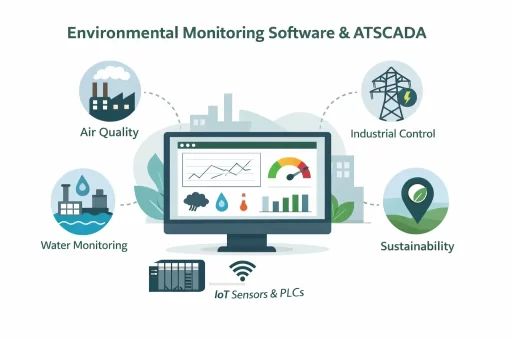
Environmental Monitoring Software is a digital solution designed to collect, analyze, and visualize environmental data from sensors and devices. It enables organizations to monitor parameters such as:
- Air quality (CO₂, NOx, SO₂, particulate matter)
- Water quality (pH, turbidity, dissolved oxygen)
- Temperature and humidity
- Noise levels
- Soil conditions
By leveraging automation and data analytics, this software transforms raw environmental data into actionable insights, helping industries make informed decisions.
Why Environmental Monitoring Matters in Modern Industry
Regulatory Compliance
Governments worldwide impose strict environmental regulations. Industries must continuously monitor emissions, waste, and environmental impact to avoid penalties. Environmental Monitoring Software simplifies compliance by:
- Automating data collection and reporting
- Generating audit-ready reports
- Providing real-time alerts for threshold violations
Sustainability and ESG Goals
Sustainability is no longer optional. Companies are expected to meet Environmental, Social, and Governance (ESG) standards. Monitoring software helps organizations:
- Track carbon footprint
- Optimize resource usage
- Reduce environmental risks
Operational Efficiency
Beyond compliance, environmental monitoring improves efficiency by identifying inefficiencies in processes such as energy consumption and waste management.
Key Features of Environmental Monitoring Software
1. Real-Time Data Acquisition
Modern systems collect data continuously from IoT sensors and industrial devices. This ensures accurate and up-to-date environmental insights.
2. Centralized Data Management
Environmental data from multiple sites is consolidated into a single platform, making it easier to analyze trends and generate reports.
3. Advanced Visualization
Dashboards, charts, and heatmaps provide intuitive visualization, helping operators quickly interpret complex data.
4. Alarm and Notification System
Users receive instant alerts when environmental parameters exceed predefined thresholds, enabling rapid response.
5. Historical Data Analysis
Trend analysis helps predict future environmental conditions and supports long-term planning.
The Role of ATSCADA in Environmental Monitoring
ATSCADA enhances Environmental Monitoring Software by integrating it into a powerful SCADA (Supervisory Control and Data Acquisition) ecosystem. This combination delivers:
Seamless Integration
ATSCADA connects with a wide range of sensors, PLCs, and IoT devices through a SCADA environment architecture with industrial integration, ensuring compatibility across industrial systems.
Real-Time Monitoring and Control
Operators can not only monitor environmental conditions but also control processes directly from a centralized interface.
Scalability
Whether for a single facility or multiple industrial sites, ATSCADA scales easily to meet growing monitoring demands.
Customizable Dashboards
Users can tailor dashboards to display critical environmental metrics relevant to their operations.
Applications of Environmental Monitoring Software
Industrial Manufacturing
Factories use Environmental Monitoring Software to control emissions, monitor workplace conditions, and ensure compliance with environmental standards.
Water Treatment Plants
Monitoring water quality parameters is essential for safe and efficient operations, supported by SCADA applications in water treatment for continuous tracking and reporting.
Smart Cities
Urban environments rely on environmental monitoring to manage air quality, noise pollution, and waste systems.
Energy and Utilities
Power plants and energy facilities use monitoring systems to track emissions and optimize resource consumption.
Benefits of Using Environmental Monitoring Software with ATSCADA
Improved Decision-Making
Real-time insights enable faster and more accurate decisions, reducing risks and improving operational outcomes.
Cost Reduction
Automation minimizes manual monitoring efforts and reduces operational costs.
Enhanced Data Accuracy
Digital systems eliminate human error and ensure reliable data collection.
Increased Transparency
Comprehensive reporting supports transparency with regulators, stakeholders, and the public.
Best Practices for Implementation
Choose Scalable Solutions
Select software that can grow with your business and adapt to future requirements.
Ensure Device Compatibility
Verify that the system supports your existing sensors and industrial equipment.
Focus on User Experience
An intuitive interface improves adoption and reduces training time.
Prioritize Data Security
Environmental data is critical. Ensure robust cybersecurity measures are in place.
Future Trends in Environmental Monitoring Software
Integration with AI and Machine Learning
Predictive analytics will enable proactive environmental management, reducing risks before they occur.
Cloud-Based Solutions
Cloud platforms offer flexibility, remote access, and cost-effective scalability.
IoT Expansion
The increasing use of IoT devices will enhance data collection and improve monitoring accuracy.
Digital Twins
Digital replicas of industrial environments will allow simulation and optimization of environmental performance.
Conclusion
Environmental Monitoring Software is an essential tool for modern industries striving to balance operational efficiency with environmental responsibility. When integrated with advanced platforms like ATSCADA, it becomes a powerful solution for real-time monitoring, compliance, and sustainability.
As industries continue to evolve, investing in smart environmental monitoring solutions is not just a regulatory necessity—it is a strategic advantage.
👉 Learn More about Industrial Automation System

ATSCADA - Smart SCADA Software with AI Predictor & Blockchain. ATSCADA is an advanced SCADA software platform for real-time monitoring, intelligent control, and efficient data acquisition. It is ideal for Industrial IoT (IIoT), smart cities, integrated automation systems, and Agriculture 4.0. With a built-in AI Predictor, ATSCADA enables predictive analytics to detect issues early, optimize performance, and reduce downtime. The integration of Blockchain technology ensures secure, transparent, and tamper-proof data management. Highly scalable and easy to integrate, ATSCADA is trusted by businesses to enhance productivity, strengthen cybersecurity, and accelerate digital transformation.
Related articles
Utility SCADA Systems for Power, Water, and Infrastructure Management
In today’s rapidly evolving industrial landscape, Utility SCADA Systems play a critical role in managing [...]
Apr
Cost of a SCADA System: Complete Pricing Guide
Understanding the Cost of a SCADA System is essential for businesses planning to implement or [...]
Apr
SCADA Software Price: Complete Cost Guide for Industrial Systems
Understanding SCADA software price is essential for any organization planning to implement or upgrade industrial [...]
Apr
Cheap SCADA Software for Small and Medium Businesses
In today’s competitive industrial landscape, small and medium businesses (SMBs) are under constant pressure to [...]
Apr
Low Cost SCADA Solutions for Efficient Industrial Automation
In today’s competitive industrial landscape, companies are under constant pressure to improve efficiency while minimizing [...]
Apr
Ignition SCADA and AI: Integrating Intelligent Automation into Modern SCADA Systems
In modern industrial environments, Ignition SCADA and AI are increasingly combined to move beyond traditional [...]
Apr