
Technical Guides
SCADA Environment: Architecture, Components, and Industrial Integration
The SCADA Environment plays a critical role in modern industrial automation, enabling real-time monitoring, control, and data acquisition across complex systems. From water treatment plants to manufacturing lines and energy grids, SCADA environments ensure operational efficiency, safety, and data-driven decision-making.
As industries continue to digitize, platforms like ATSCADA are redefining how SCADA environments are designed—making them more open, scalable, and adaptable to Industry 4.0 requirements.
What Is a SCADA Environment?
A SCADA Environment refers to the complete ecosystem of hardware, software, networks, and protocols used to monitor and control industrial processes. It is not just a single system but an integrated infrastructure that connects field devices with centralized control systems.
Key Characteristics
- Real-time data acquisition and visualization
- Remote monitoring and control capabilities
- Integration with industrial protocols (Modbus, OPC, etc.)
- Scalability for large and distributed systems
- High reliability and redundancy
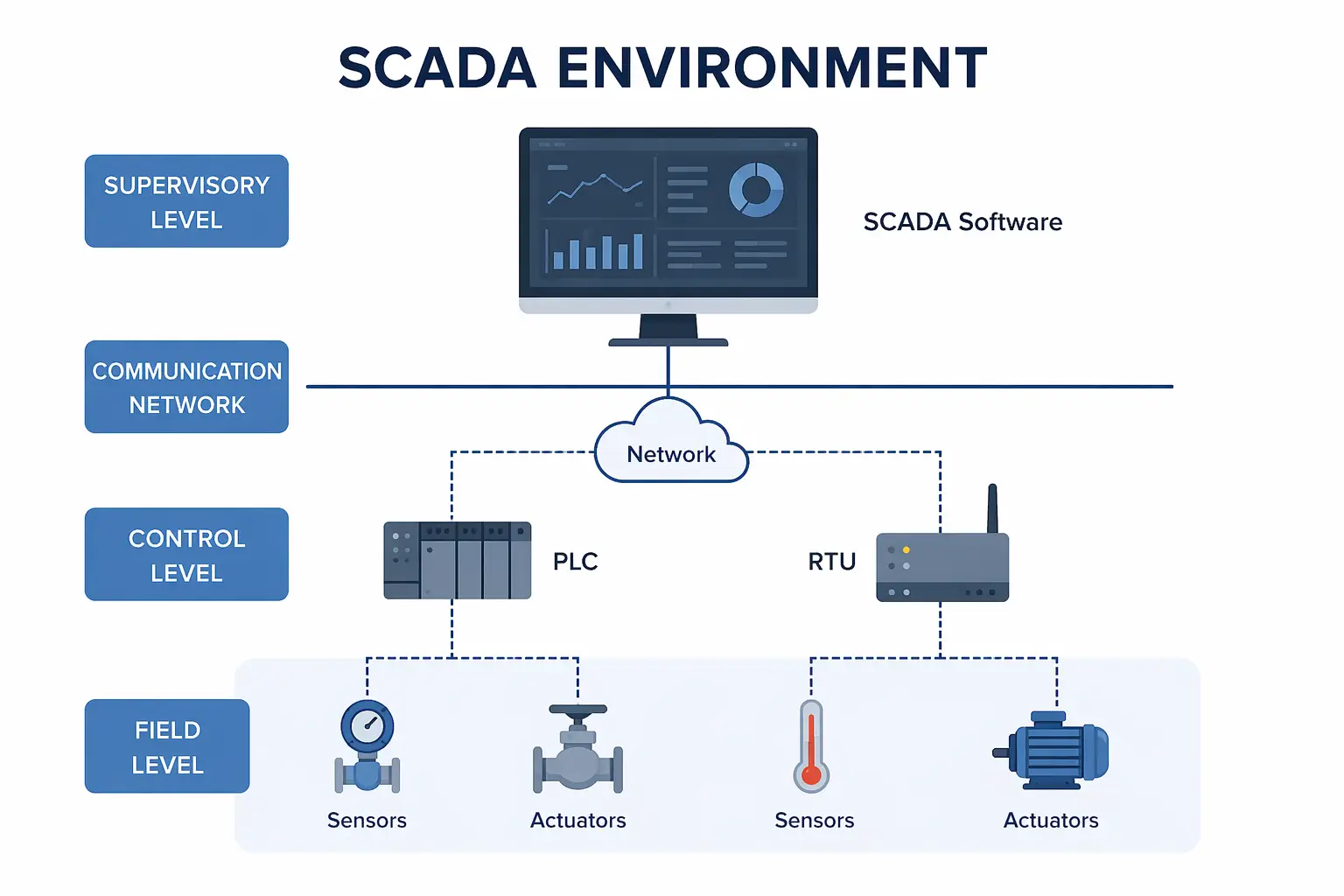
SCADA Environment Architecture
Understanding the architecture of a SCADA environment is essential for designing efficient and scalable systems.
1. Field Level (Sensors and Actuators)
At the lowest level, sensors collect real-time data such as temperature, pressure, and flow. Actuators execute control commands.
2. Control Level (PLCs and RTUs)
- PLCs (Programmable Logic Controllers) handle local automation
- RTUs (Remote Terminal Units) collect and transmit data from remote locations
3. Communication Network
This layer connects field devices to central systems using protocols such as:
- Modbus TCP/RTU
- OPC UA
- MQTT (in modern SCADA environments)
4. Supervisory Level (SCADA Software)
This is where platforms like ATSCADA operate, providing:
- Data visualization (HMI dashboards)
- Alarm management
- Historical data logging
- System analytics
5. Enterprise Level
Integration with ERP, MES, or cloud platforms enables advanced analytics and business intelligence.
Core Components of a SCADA Environment
Human-Machine Interface (HMI)
The HMI allows operators to interact with the system through graphical dashboards. Modern SCADA environments emphasize web-based HMIs for accessibility and flexibility.
SCADA Software Platform
This is the central brain of the system. A modern solution like ATSCADA offers:
- Web-based deployment
- Cross-platform compatibility
- Open architecture
- Easy integration with third-party systems
Data Historian
Stores historical data for analysis, reporting, and optimization.
Alarm Management System
Detects abnormal conditions and alerts operators in real time.
Communication Gateways
Ensure seamless data exchange between different devices and protocols.
Industrial Integration of SCADA Environment
Manufacturing
In manufacturing, SCADA environments enable:
- Production monitoring
- Equipment performance tracking
- Predictive maintenance
Water and Wastewater Management
SCADA systems are essential for:
- Monitoring water levels and flow rates
- Controlling pumps and valves
- Ensuring regulatory compliance
Energy and Utilities
SCADA environments support:
- Power grid monitoring
- Load balancing
- Fault detection
Oil and Gas
Used for pipeline monitoring, leak detection, and remote asset management.
Benefits of a Modern SCADA Environment
1. Real-Time Visibility
Operators gain instant insights into system performance, which is critical for a SCADA system in water treatment plants where continuous monitoring is essential.
2. Improved Efficiency
Automation reduces manual intervention and minimizes errors.
3. Scalability
Modern SCADA environments can expand easily as operations grow.
4. Enhanced Security
Advanced systems include cybersecurity measures to protect critical infrastructure.
5. Data-Driven Optimization
Historical data and analytics improve long-term operational strategies.
How ATSCADA Enhances SCADA Environments
ATSCADA is designed to address the limitations of traditional SCADA systems by offering a more flexible and open approach.
Key Advantages of ATSCADA
- Web-Based SCADA: Access from anywhere without installing heavy software
- Open Architecture: Easy integration with existing systems
- Protocol Support: Native support for Modbus and other industrial standards
- Customizable Dashboards: Tailored visualization for different industries
- Cloud-Ready: Seamless integration with cloud platforms
Unlike legacy systems, ATSCADA focuses on usability and scalability, making it suitable for both small and large industrial applications.
Challenges in SCADA Environment Implementation
Despite its advantages, implementing a SCADA environment comes with challenges:
Integration Complexity
Connecting legacy systems with modern platforms can be difficult.
Cybersecurity Risks
SCADA systems are increasingly targeted by cyber threats, requiring robust protection.
High Initial Investment
Infrastructure setup can be costly, although long-term benefits outweigh the cost.
Skill Requirements
Operators and engineers must be trained to manage advanced SCADA systems.
Future Trends in SCADA Environment
1. Cloud-Based SCADA
More organizations are moving toward cloud-native SCADA environments for scalability and remote access.
2. IIoT Integration
The Industrial Internet of Things (IIoT) enhances data collection and system intelligence.
3. AI and Predictive Analytics
Machine learning enables predictive maintenance and anomaly detection.
4. Edge Computing
Processing data closer to the source reduces latency and improves performance.
Best Practices for Designing a SCADA Environment
- Use open and scalable platforms like ATSCADA
- Ensure compatibility with industrial protocols
- Implement strong cybersecurity measures
- Design user-friendly HMI interfaces
- Plan for future scalability and upgrades
Conclusion
The SCADA Environment is the backbone of modern industrial automation, enabling seamless monitoring, control, and optimization of complex systems. As industries evolve, the demand for flexible, scalable, and intelligent SCADA solutions continues to grow.
Platforms like ATSCADA are leading this transformation by offering open, web-based, and highly adaptable SCADA environments. By understanding the architecture, components, and integration strategies, businesses can build robust systems that drive efficiency and innovation.

ATSCADA - Smart SCADA Software with AI Predictor & Blockchain. ATSCADA is an advanced SCADA software platform for real-time monitoring, intelligent control, and efficient data acquisition. It is ideal for Industrial IoT (IIoT), smart cities, integrated automation systems, and Agriculture 4.0. With a built-in AI Predictor, ATSCADA enables predictive analytics to detect issues early, optimize performance, and reduce downtime. The integration of Blockchain technology ensures secure, transparent, and tamper-proof data management. Highly scalable and easy to integrate, ATSCADA is trusted by businesses to enhance productivity, strengthen cybersecurity, and accelerate digital transformation.
Related articles
Utility SCADA Systems for Power, Water, and Infrastructure Management
In today’s rapidly evolving industrial landscape, Utility SCADA Systems play a critical role in managing [...]
Apr
Cost of a SCADA System: Complete Pricing Guide
Understanding the Cost of a SCADA System is essential for businesses planning to implement or [...]
Apr
SCADA Software Price: Complete Cost Guide for Industrial Systems
Understanding SCADA software price is essential for any organization planning to implement or upgrade industrial [...]
Apr
Cheap SCADA Software for Small and Medium Businesses
In today’s competitive industrial landscape, small and medium businesses (SMBs) are under constant pressure to [...]
Apr
Low Cost SCADA Solutions for Efficient Industrial Automation
In today’s competitive industrial landscape, companies are under constant pressure to improve efficiency while minimizing [...]
Apr
Ignition SCADA and AI: Integrating Intelligent Automation into Modern SCADA Systems
In modern industrial environments, Ignition SCADA and AI are increasingly combined to move beyond traditional [...]
Apr