
Technical Guides
SCADA Software PLC: Integrating Control and Intelligence in Modern Industry
In modern industrial environments, efficiency, accuracy, and real-time visibility are no longer optional—they are essential. One of the most critical integrations enabling this transformation is scada software plc systems, widely used in modern industrial SCADA software environments systems.
By combining the control capabilities of PLCs (Programmable Logic Controllers) with the monitoring and analytics power of SCADA software, businesses can create intelligent, scalable systems that drive productivity and operational excellence.
Platforms like ATSCADA are at the forefront of this evolution, offering a unified approach to industrial automation.
What Is SCADA Software PLC?
SCADA software PLC refers to the integration between SCADA (Supervisory Control and Data Acquisition) systems and PLC controllers.
Key Components
- PLC (Programmable Logic Controller):
Responsible for executing control logic and interacting with field devices. - SCADA Software:
Provides visualization, data collection, and supervisory control. - Communication Protocols:
Such as Modbus, OPC UA, and MQTT for seamless data exchange.
Together, these components form a complete automation ecosystem where PLCs handle real-time control, and SCADA software provides centralized monitoring and decision-making tools.
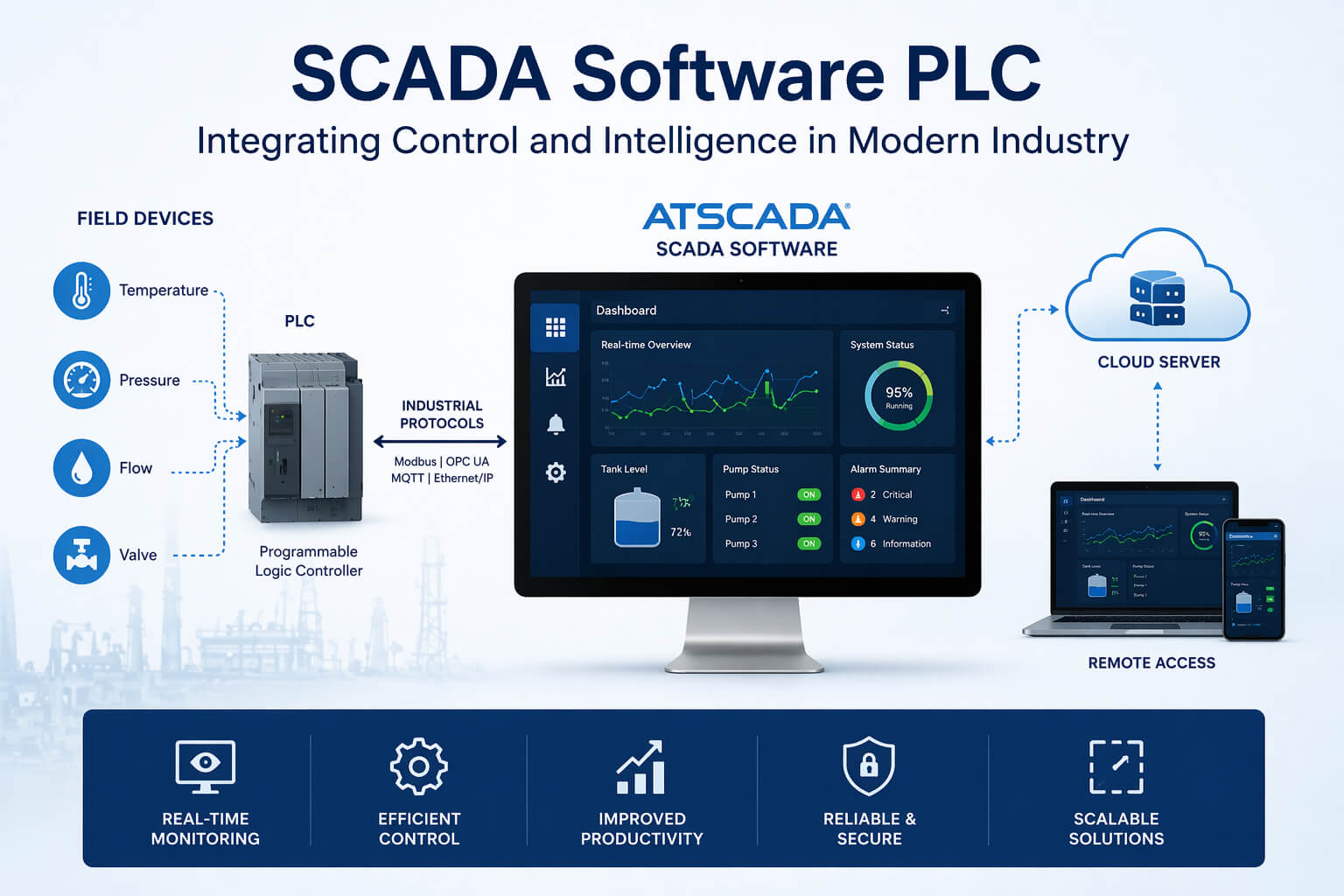
How SCADA Software PLC Systems Work
Understanding how scada software plc systems function helps highlight their importance in industrial operations.
Data Acquisition from PLCs
PLCs collect real-time data from sensors, including:
- Temperature
- Pressure
- Flow rates
- Machine status
Data Transmission
Using industrial protocols, PLCs send data to the SCADA system. Modern platforms like ATSCADA simplify this process with built-in connectivity.
Data Processing and Visualization
SCADA software processes incoming data and presents it through intuitive dashboards using advanced SCADA monitoring software tools, allowing operators to:
- Monitor system performance
- Identify anomalies
- Control processes remotely
Control Feedback Loop
Operators or automated rules send commands back to PLCs, ensuring continuous optimization.
Benefits of SCADA Software PLC Integration
Integrating scada software plc systems offers significant advantages across industries.
Improved Operational Efficiency
Real-time monitoring allows faster response to issues, reducing downtime and increasing productivity.
Enhanced Decision-Making
Accurate and centralized data enables managers to make informed decisions quickly.
Increased System Reliability
PLCs ensure deterministic control, while SCADA provides system-wide visibility.
Scalability
Modern systems like ATSCADA are designed to scale with business growth, supporting additional devices and sites.
ATSCADA: A Modern SCADA Software PLC Solution
Traditional systems often struggle with complexity and limited flexibility. ATSCADA introduces a new approach to scada software plc integration.
Unified Platform
ATSCADA combines monitoring, control, and analytics into a single platform, eliminating the need for multiple disconnected systems.
Seamless PLC Integration
Supports various PLC brands and protocols, ensuring compatibility with both legacy and modern equipment.
High Performance
- Fast data processing
- Stable communication
- Reliable uptime
Customizable Dashboards
Operators can design interfaces tailored to their workflows, improving usability and efficiency.
Cloud and IoT Support
ATSCADA enables:
- Remote monitoring
- Multi-site management
- IoT device integration
Applications of SCADA Software PLC Systems
The flexibility of scada software plc systems makes them suitable for a wide range of industries.
Manufacturing
- Monitor production lines
- Track machine performance
- Improve product quality
Energy and Utilities
- Manage power distribution
- Monitor renewable energy systems
- Optimize energy consumption
Water and Wastewater
- Monitor tank levels
- Control pumps and valves
- Ensure system reliability
Best Practices for Implementing SCADA Software PLC
To maximize the value of your scada software plc system, consider the following practices:
Design for Usability
Interfaces should be intuitive, allowing operators to quickly understand system status.
Ensure Reliable Communication
Choose robust protocols and ensure network stability.
Plan for Scalability
Your system should support future expansion without major redesign.
Focus on Cybersecurity
Protect your system with:
- Secure communication
- User access control
- Network segmentation
ATSCADA incorporates advanced security features to safeguard industrial operations.
Common Challenges and Solutions
Legacy System Integration
Older PLCs may lack modern communication capabilities.
Solution: Use flexible platforms like ATSCADA that support multiple protocols.
Data Overload
Too much data can overwhelm operators.
Solution: Use structured dashboards and smart filtering.
System Complexity
Traditional systems can be difficult to manage.
Solution: Adopt user-friendly SCADA platforms.
Downtime Risks
System interruptions can be costly.
Solution: Implement redundancy and high-availability architectures.
The Future of SCADA Software PLC
The future of scada software plc systems is closely tied to digital transformation.
Key Trends
- AI-driven analytics
- Cloud-based SCADA platforms
- Edge computing
- Digital twin technology
ATSCADA continues to evolve with these trends, helping businesses stay competitive in a rapidly changing industrial landscape.
Conclusion
The integration of scada software plc is a cornerstone of modern industrial automation. By combining real-time control with advanced monitoring and analytics, these systems enable smarter, more efficient operations.
With solutions like ATSCADA, businesses can move beyond traditional automation and build scalable, intelligent systems that support long-term growth.
Instead of simply controlling processes, organizations can leverage data to drive innovation, improve performance, and maintain a competitive edge.

ATSCADA - Smart SCADA Software with AI Predictor & Blockchain. ATSCADA is an advanced SCADA software platform for real-time monitoring, intelligent control, and efficient data acquisition. It is ideal for Industrial IoT (IIoT), smart cities, integrated automation systems, and Agriculture 4.0. With a built-in AI Predictor, ATSCADA enables predictive analytics to detect issues early, optimize performance, and reduce downtime. The integration of Blockchain technology ensures secure, transparent, and tamper-proof data management. Highly scalable and easy to integrate, ATSCADA is trusted by businesses to enhance productivity, strengthen cybersecurity, and accelerate digital transformation.
Related articles
Utility SCADA Systems for Power, Water, and Infrastructure Management
In today’s rapidly evolving industrial landscape, Utility SCADA Systems play a critical role in managing [...]
Apr
Cost of a SCADA System: Complete Pricing Guide
Understanding the Cost of a SCADA System is essential for businesses planning to implement or [...]
Apr
SCADA Software Price: Complete Cost Guide for Industrial Systems
Understanding SCADA software price is essential for any organization planning to implement or upgrade industrial [...]
Apr
Cheap SCADA Software for Small and Medium Businesses
In today’s competitive industrial landscape, small and medium businesses (SMBs) are under constant pressure to [...]
Apr
Low Cost SCADA Solutions for Efficient Industrial Automation
In today’s competitive industrial landscape, companies are under constant pressure to improve efficiency while minimizing [...]
Apr
Ignition SCADA and AI: Integrating Intelligent Automation into Modern SCADA Systems
In modern industrial environments, Ignition SCADA and AI are increasingly combined to move beyond traditional [...]
Apr