
Technical Guides
SCADA Applications in Water Treatment: Real-World Use Cases and Benefits
Water treatment facilities are under increasing pressure to deliver clean, safe water while maintaining efficiency and regulatory compliance. As operations grow more complex, digital transformation becomes essential. One of the most impactful technologies driving this change is SCADA Applications in Water Treatment, enabling real-time monitoring, automation, and intelligent decision-making.
In this article, we explore how SCADA is applied in water treatment plants, highlight real-world use cases, and explain how solutions like ATSCADA support modern infrastructure.
What Are SCADA Applications in Water Treatment?
SCADA (Supervisory Control and Data Acquisition) applications in water treatment refer to the use of centralized systems to monitor, control, and optimize treatment processes. These systems collect data from sensors and equipment, process it in real time, and present it through intuitive dashboards within a SCADA system in water treatment plants.
Core Functions of SCADA Applications
- Real-time monitoring of water quality parameters
- Automated control of pumps, valves, and dosing systems
- Alarm management and fault detection
- Historical data logging and reporting
- Remote access and supervisory control
These capabilities make SCADA an essential tool for both municipal and industrial water treatment facilities.
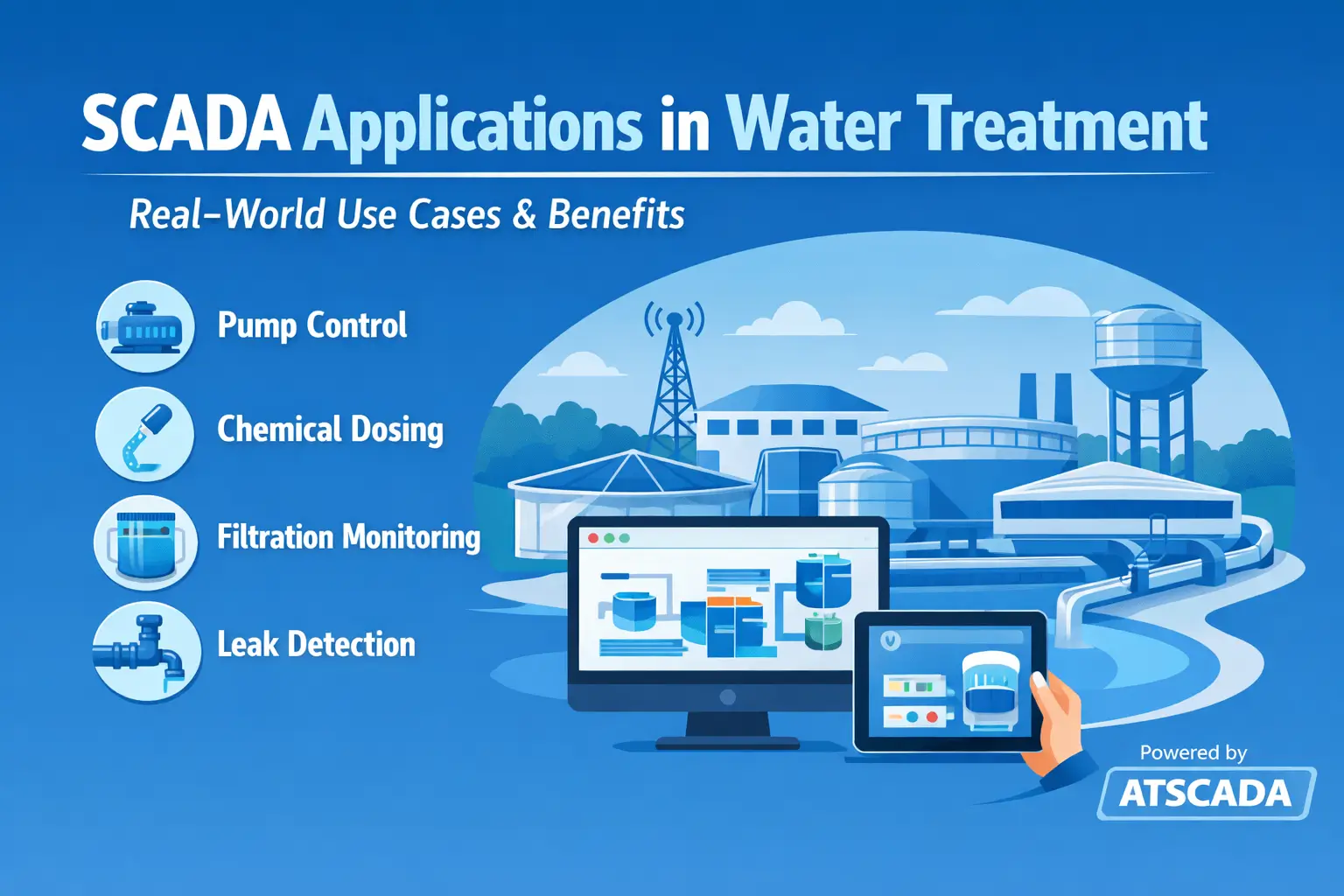
Key SCADA Applications in Water Treatment Plants
1. Water Intake and Pumping Stations
SCADA systems monitor water levels, flow rates, and pump status at intake points. Operators can control pumps remotely, optimize energy usage, and prevent overflow or dry running.
2. Chemical Dosing Automation
Accurate chemical dosing is critical for maintaining water quality. SCADA applications automatically adjust dosing levels based on real-time sensor data, reducing waste and improving safety.
3. Filtration and Sedimentation Control
SCADA systems track filter performance, turbidity levels, and sedimentation efficiency. When abnormalities occur, alerts are triggered to ensure timely intervention.
4. Distribution Network Monitoring
Beyond treatment plants, SCADA applications extend to water distribution systems. Operators can detect leaks, monitor pressure, and ensure consistent water supply across networks.
5. Wastewater Treatment Management
SCADA is widely used in wastewater treatment for aeration control, sludge management, and effluent quality monitoring, ensuring compliance with environmental standards.
Benefits of SCADA Applications in Water Treatment
Improved Operational Efficiency
Automation reduces manual intervention and human error. Processes become more consistent, leading to optimized resource usage and lower operational costs.
Enhanced Water Quality Control
Continuous monitoring ensures that water quality parameters remain within acceptable limits. Immediate alerts help prevent contamination and ensure safety.
Real-Time Decision Making
Operators can make informed decisions based on live data, improving response time and overall system reliability.
Cost Savings and Energy Optimization
SCADA systems help optimize pump operations and chemical usage, significantly reducing energy consumption and operational expenses.
Regulatory Compliance
With built-in reporting and data logging features, SCADA applications simplify compliance with environmental and safety regulations.
How ATSCADA Enhances SCADA Applications in Water Treatment
ATSCADA provides a modern and flexible platform designed to support advanced SCADA applications in industrial environments, including water treatment.
Open and Scalable Architecture
ATSCADA allows seamless integration with various devices and protocols, making it ideal for both new installations and system upgrades.
Advanced Web-Based Monitoring
With web-enabled SCADA capabilities, operators can access system data anytime, anywhere, improving operational flexibility.
Reliable Communication with Industrial Protocols
ATSCADA supports protocols like Modbus, ensuring stable and efficient communication between devices.
User-Friendly Interface and Visualization
Intuitive dashboards and visualization tools make it easier for operators to monitor complex systems and respond quickly to issues.
Real-World Examples of SCADA Applications in Water Treatment
Municipal Water Treatment Plant
A city water treatment facility uses SCADA to monitor intake levels, automate chemical dosing, and manage distribution networks. This results in improved efficiency and reduced operational costs.
Industrial Water Treatment System
Manufacturing plants rely on SCADA to ensure water quality for production processes. Real-time monitoring helps prevent contamination and maintain consistent output.
Wastewater Treatment Facility
SCADA systems optimize aeration processes, monitor sludge levels, and ensure compliance with discharge regulations, reducing environmental impact.
Challenges in SCADA Implementation
Integration Complexity
Connecting SCADA systems with legacy equipment can be challenging and may require additional hardware or customization.
Cybersecurity Concerns
As SCADA systems become more connected, they are increasingly vulnerable to cyber threats. Strong security measures are essential.
Initial Investment
Although SCADA systems provide long-term savings, initial implementation costs can be significant. However, the ROI is typically high.
Best Practices for Deploying SCADA Applications
Start with a Clear Strategy
Define goals, system requirements, and expected outcomes before implementation.
Choose a Flexible Platform
Select scalable solutions like ATSCADA that can adapt to future needs.
Ensure Data Accuracy
Regular calibration and maintenance of sensors are crucial for reliable system performance.
Prioritize Security
Implement secure communication protocols and access control to protect system integrity.
Future Trends in SCADA Applications for Water Treatment
IoT Integration
Smart sensors and IoT devices enhance data collection and enable predictive maintenance.
Cloud-Based SCADA
Cloud solutions offer scalability, remote access, and reduced infrastructure costs.
AI and Predictive Analytics
Artificial intelligence helps optimize processes and predict equipment failures before they occur.
Sustainable Water Management
Modern utility SCADA systems play a key role in reducing waste, improving efficiency, and supporting sustainable water management.
Conclusion
SCADA Applications in Water Treatment are transforming how facilities operate, making them more efficient, reliable, and sustainable. From real-time monitoring to advanced automation, SCADA systems provide the tools needed to meet modern challenges.
With its open architecture, advanced features, and strong industrial compatibility, ATSCADA is a powerful solution for implementing effective SCADA applications in water treatment. Investing in the right SCADA platform is not just a technological upgrade—it is a strategic move toward smarter water management.
ATSCADA - Smart SCADA Software with AI Predictor & Blockchain. ATSCADA is an advanced SCADA software platform for real-time monitoring, intelligent control, and efficient data acquisition. It is ideal for Industrial IoT (IIoT), smart cities, integrated automation systems, and Agriculture 4.0. With a built-in AI Predictor, ATSCADA enables predictive analytics to detect issues early, optimize performance, and reduce downtime. The integration of Blockchain technology ensures secure, transparent, and tamper-proof data management. Highly scalable and easy to integrate, ATSCADA is trusted by businesses to enhance productivity, strengthen cybersecurity, and accelerate digital transformation.
Related articles
Utility SCADA Systems for Power, Water, and Infrastructure Management
In today’s rapidly evolving industrial landscape, Utility SCADA Systems play a critical role in managing [...]
Apr
Cost of a SCADA System: Complete Pricing Guide
Understanding the Cost of a SCADA System is essential for businesses planning to implement or [...]
Apr
SCADA Software Price: Complete Cost Guide for Industrial Systems
Understanding SCADA software price is essential for any organization planning to implement or upgrade industrial [...]
Apr
Cheap SCADA Software for Small and Medium Businesses
In today’s competitive industrial landscape, small and medium businesses (SMBs) are under constant pressure to [...]
Apr
Low Cost SCADA Solutions for Efficient Industrial Automation
In today’s competitive industrial landscape, companies are under constant pressure to improve efficiency while minimizing [...]
Apr
Ignition SCADA and AI: Integrating Intelligent Automation into Modern SCADA Systems
In modern industrial environments, Ignition SCADA and AI are increasingly combined to move beyond traditional [...]
Apr