
Technical Guides
SCADA Software HMI: Turning Industrial Data into Action
Industrial systems generate enormous amounts of data every second. However, raw data alone does not improve performance—what matters is how that data is presented and used.
This is exactly where scada software hmi becomes essential.
A well-designed HMI (Human Machine Interface) acts as the bridge between machines and operators. It transforms complex system signals into clear, actionable visuals. With platforms like ATSCADA, businesses can build HMI systems that are not only powerful but also intuitive and scalable.
Understanding SCADA Software HMI in Practice
Rather than thinking of HMI as just a “screen,” it’s better to view it as a decision-making interface.
A typical scada software hmi environment allows operators to:
- Observe system conditions in real time
- Control machines and processes
- Respond instantly to abnormal events
- Analyze trends and performance
In other words, HMI is where data becomes action.
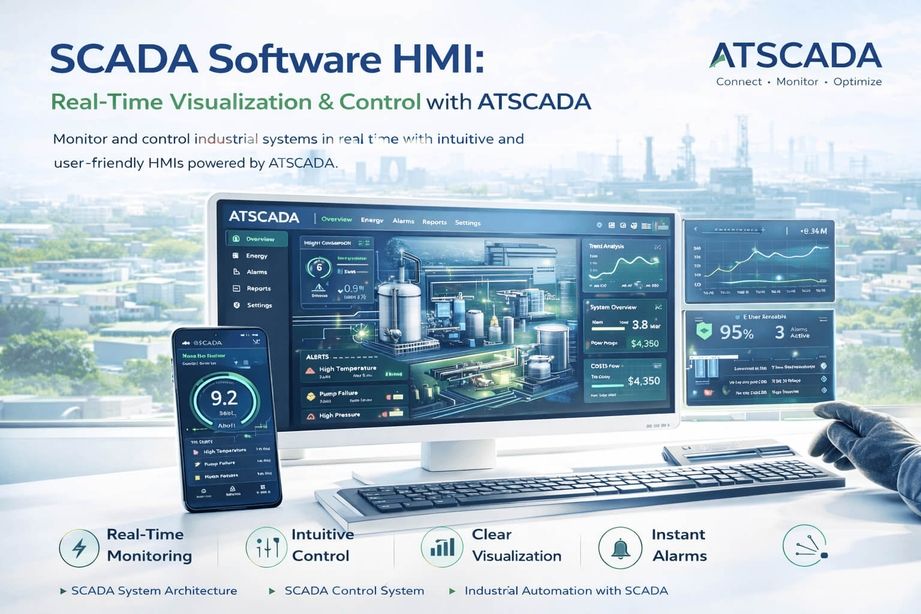
From Signals to Screens: How HMI Works
To understand HMI better, let’s break down the flow inside a SCADA system:
Step 1: Data Collection
Sensors and PLCs gather raw signals such as temperature, pressure, and energy usage.
Step 2: Data Processing
The SCADA platform processes and organizes this data into usable formats.
Step 3: Visualization (HMI Layer)
This is where scada software hmi plays its role—displaying data through:
- Dynamic charts
- Status indicators
- Interactive controls
Step 4: Operator Interaction
Operators take action based on what they see—adjusting parameters, triggering alarms, or stopping systems.
ATSCADA optimizes this entire pipeline with fast, real-time visualization.
What Makes a High-Quality SCADA Software HMI?
Not all HMIs are effective. The difference lies in design quality.
Clarity Over Complexity
A good scada software hmi avoids clutter. Instead of showing everything, it shows what matters most.
Contextual Information
Data must be presented with meaning.
For example:
- A number alone is useless
- A number with thresholds and trends is powerful
Visual Hierarchy
Operators should instantly recognize:
- Critical alerts
- System status
- Key performance indicators
Responsiveness
Industrial environments require immediate feedback. Even small delays can cause serious issues.
ATSCADA is designed to deliver low-latency, real-time updates, ensuring operators always work with accurate data.
ATSCADA and the Evolution of HMI Design
Traditional HMI systems were often rigid and difficult to customize. ATSCADA changes this approach completely.
Drag-and-Drop Interface Design
Instead of coding everything manually, developers and SCADA software engineers can:
- Build dashboards visually
- Arrange components quickly
- Customize layouts easily
Unified Data Visualization
ATSCADA allows integration of multiple data sources into a single HMI.
This means operators can:
- Monitor entire systems from one screen
- Reduce switching between interfaces
- Improve situational awareness
Adaptive Display Across Devices
Modern operations are no longer limited to control rooms.
ATSCADA supports:
- Desktop dashboards
- Tablet interfaces
- Mobile monitoring
This flexibility is critical for modern industrial workflows.
Real Use Cases: How SCADA Software HMI Is Applied
Production Monitoring in Factories
Operators track machine performance, detect downtime, and optimize output—all through a centralized HMI.
Energy Management Systems
In energy environments, scada software hmi integrated with SCADA EMS software solutions helps visualize:
- Power consumption
- Load distribution
- Efficiency metrics
Water Treatment Facilities
HMI dashboards display:
- Tank levels
- Pump status
- Flow rates
Operators can quickly respond to anomalies.
Smart Infrastructure
From buildings to transportation systems, HMI enables centralized monitoring and control.
Designing HMI That Operators Actually Use
A technically correct system is not enough—it must also be usable.
Here are practical design principles:
Focus on Operator Behavior
Design based on how users actually interact with the system, not how engineers think.
Limit Screen Density
Too many elements reduce readability. Prioritize essential data.
Use Meaningful Colors
- Red → critical alerts
- Green → normal operation
- Yellow → warnings
Standardize Layouts
Consistency reduces training time and errors.
Common Pitfalls in SCADA Software HMI
Even advanced systems fail when design is ignored.
Overloading the Interface
Too much information leads to confusion.
Ignoring User Experience
A system that looks good but is hard to use is ineffective.
Poor Alarm Design
Too many alarms → operators start ignoring them.
Lack of Scalability
Systems that cannot grow become obsolete quickly.
ATSCADA helps avoid these issues through structured and flexible HMI development.
The Future of SCADA Software HMI
HMI technology is evolving rapidly alongside Industry 4.0.
Key trends include:
- AI-assisted visualization
- Predictive dashboards
- Cloud-based HMI systems
- Integration with digital twins
ATSCADA continues to adapt to these trends, helping businesses stay competitive.
Conclusion: More Than Just a Display
A scada software hmi is not just a visual interface—it is the control center of industrial operations.
It enables operators to understand systems, make decisions, and act in real time.
With ATSCADA, organizations can design HMI systems that are:
- Intuitive
- Scalable
- High-performance
In a world driven by data, the ability to visualize and act on information is what defines successful industrial systems.

ATSCADA - Smart SCADA Software with AI Predictor & Blockchain. ATSCADA is an advanced SCADA software platform for real-time monitoring, intelligent control, and efficient data acquisition. It is ideal for Industrial IoT (IIoT), smart cities, integrated automation systems, and Agriculture 4.0. With a built-in AI Predictor, ATSCADA enables predictive analytics to detect issues early, optimize performance, and reduce downtime. The integration of Blockchain technology ensures secure, transparent, and tamper-proof data management. Highly scalable and easy to integrate, ATSCADA is trusted by businesses to enhance productivity, strengthen cybersecurity, and accelerate digital transformation.
Related articles
Utility SCADA Systems for Power, Water, and Infrastructure Management
In today’s rapidly evolving industrial landscape, Utility SCADA Systems play a critical role in managing [...]
Apr
Cost of a SCADA System: Complete Pricing Guide
Understanding the Cost of a SCADA System is essential for businesses planning to implement or [...]
Apr
SCADA Software Price: Complete Cost Guide for Industrial Systems
Understanding SCADA software price is essential for any organization planning to implement or upgrade industrial [...]
Apr
Cheap SCADA Software for Small and Medium Businesses
In today’s competitive industrial landscape, small and medium businesses (SMBs) are under constant pressure to [...]
Apr
Low Cost SCADA Solutions for Efficient Industrial Automation
In today’s competitive industrial landscape, companies are under constant pressure to improve efficiency while minimizing [...]
Apr
Ignition SCADA and AI: Integrating Intelligent Automation into Modern SCADA Systems
In modern industrial environments, Ignition SCADA and AI are increasingly combined to move beyond traditional [...]
Apr