
SCADA Software
ATSCADA Industrial Network Structure: Modern Automation Connectivity Solution
Modern industrial facilities require a reliable communication structure that connects field devices, local control stations, and remote monitoring centers. The ATSCADA Industrial Network is designed to provide a distributed, scalable, and secure architecture that links every layer of industrial automation—from sensors and PLCs on the factory floor to cloud-based supervision and remote control.
Built on advanced .NET technologies, API connectivity, and industrial communication standards, the ATSCADA Industrial Network helps manufacturers solve complex connectivity challenges while improving operational efficiency, data visibility, and system reliability.
What Is the ATSCADA Industrial Network?
The ATSCADA Industrial Network is a multi-tier industrial communication architecture that connects:
- Field devices and sensors
- PLCs and industrial controllers
- Driver servers and OPC servers
- Local HMI/SCADA control centers
- Cloud platforms and remote control centers
This architecture allows industrial plants to monitor operations in real time, control equipment locally, and manage multiple sites remotely through secure WAN or Internet connections.
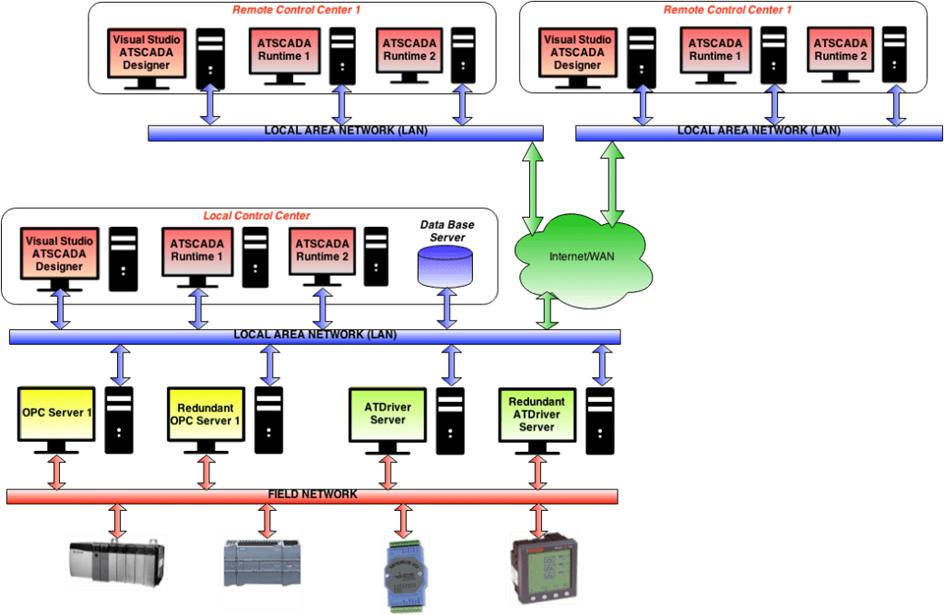
Multi-Tier Architecture of the ATSCADA Industrial Network
Field Network Layer
The Field Network is the foundation of the ATSCADA Industrial Network.
Main Components:
- PLCs such as Mitsubishi and Omron
- Modbus I/O modules
- Power meters
- Sensors
- Inverters and drives
- Process instruments
Main Functions:
- Collecting real-time production data
- Measuring temperature, pressure, flow, and machine status
- Executing control commands from upper control levels
- Providing accurate signals for automation logic
Driver & OPC Server Layer
This layer is one of the most critical parts of the ATSCADA Industrial Network. Where the ATSCADA iDriver manages communication, data exchange, and real-time connectivity between devices and control systems.
Key Components:
- ATDriver Server
- OPC Server
- Redundant Driver Server
- Redundant OPC Server
Supported Protocols:
- Modbus RTU
- Modbus TCP
- MQTT
- OPC UA
High Availability:
If the primary server fails, the backup server automatically takes over. This redundancy design prevents communication loss and minimizes downtime.
Local Control Center Layer
The Local Control Center manages plant operations inside the facility through a local area network (LAN).
Main Components:
- ATSCADA Designer
- ATSCADA Runtime Stations
- Database Server
ATSCADA Designer:
Engineers can develop HMI and SCADA interfaces using a professional design environment based on Visual Studio, supported by the ATSCADA iTools complete guide for configuring components and user interfaces efficiently. A major advantage is that the design platform does not require expensive development licensing fees.
Runtime Stations:
- Monitor alarms
- View live process data
- Control machines
- Manage production status
Database Server:
- Historical trends
- Event logs
- Alarm history
- Reports
- Production records

Internet/WAN & Remote Control Layer
The ATSCADA Industrial Network includes secure remote access capabilities through WAN and Internet connections.
Main Functions:
- Upload plant data to cloud systems
- Connect multiple factories to one control center
- Enable remote engineering access
- Support mobile monitoring via smartphone, laptop, or PC
Remote Control Center:
Organizations can deploy one or multiple remote centers with full functionality similar to the local site, including engineering access, runtime monitoring, alarm management, and remote control authorization.
Technical Advantages of the ATSCADA Industrial Network
- Built on Visual Studio .NET with API integration
- Service-based and scalable architecture
- Easy integration with AI, ERP, MES, and reporting tools
- Redundancy support for stable operation
- Improved cybersecurity readiness
Business Benefits of the ATSCADA Industrial Network
1. Complete Automation
Reduce manual intervention and improve plant productivity through centralized automation.
2. Lower Operating Costs
Decrease field inspection costs, maintenance expenses, and engineering travel through remote diagnostics.
3. Centralized Management
Collect data from multiple distributed plants into one control center using WAN infrastructure.
4. Faster Decision-Making
Real-time dashboards and alarm systems help managers react quickly to production issues.
Why Choose ATSCADA Industrial Network?
The ATSCADA Industrial Network is more than a communication platform. It connects field devices, local control rooms, and remote management centers in one scalable structure.
Whether your business operates a single factory or multiple distributed facilities, ATSCADA delivers the flexibility, reliability, and performance needed for modern industry.
Conclusion
As industrial operations become more connected, businesses need a network architecture that can scale securely and efficiently. The ATSCADA Industrial Network provides exactly that by linking field equipment, SCADA control systems, databases, and remote users into one unified platform.
From factory floor devices to enterprise-level management, ATSCADA creates a future-ready industrial network built for performance, uptime, and growth.
👉 Learn More about ATSCADA Software

ATSCADA - Smart SCADA Software with AI Predictor & Blockchain. ATSCADA is an advanced SCADA software platform for real-time monitoring, intelligent control, and efficient data acquisition. It is ideal for Industrial IoT (IIoT), smart cities, integrated automation systems, and Agriculture 4.0. With a built-in AI Predictor, ATSCADA enables predictive analytics to detect issues early, optimize performance, and reduce downtime. The integration of Blockchain technology ensures secure, transparent, and tamper-proof data management. Highly scalable and easy to integrate, ATSCADA is trusted by businesses to enhance productivity, strengthen cybersecurity, and accelerate digital transformation.
Related articles
ATSCADA iStreamCameraTools – Industrial IP Camera Integration and Real-Time Video Monitoring
The iStreamCameraTools toolkit enables the connection of ONVIF-compatible cameras to receive camera streams and display [...]
Jun
OPC Server Connection Guide
Overview The ATSCADA ecosystem provides exceptional flexibility for integrating data from third-party OPC Servers (such [...]
Jun
Common ATSCADA Errors and How to Fix Them – FAQ for ATSCADA Tools and Systems
Issues Related to ATDriverServer & iTagBuilder Software Why Does ATDriverServer Not Open? There are two [...]
May
ATSCADA Hospital Temperature and Humidity Monitoring Alarm System Project
Requirements: The system includes three monitoring areas: the pharmacy, inpatient warehouse, and cold storage, following [...]
May
ATSCADA CookBook: Complete Guide to System Architecture, Tools, Installation & Troubleshooting
The ATSCADA Training book is an essential navigation structure that helps users access all major [...]
Apr
ATSCADA Power Management System
Requirements: There are 3 areas that require power management, including a factory, a residential zone, [...]
Apr